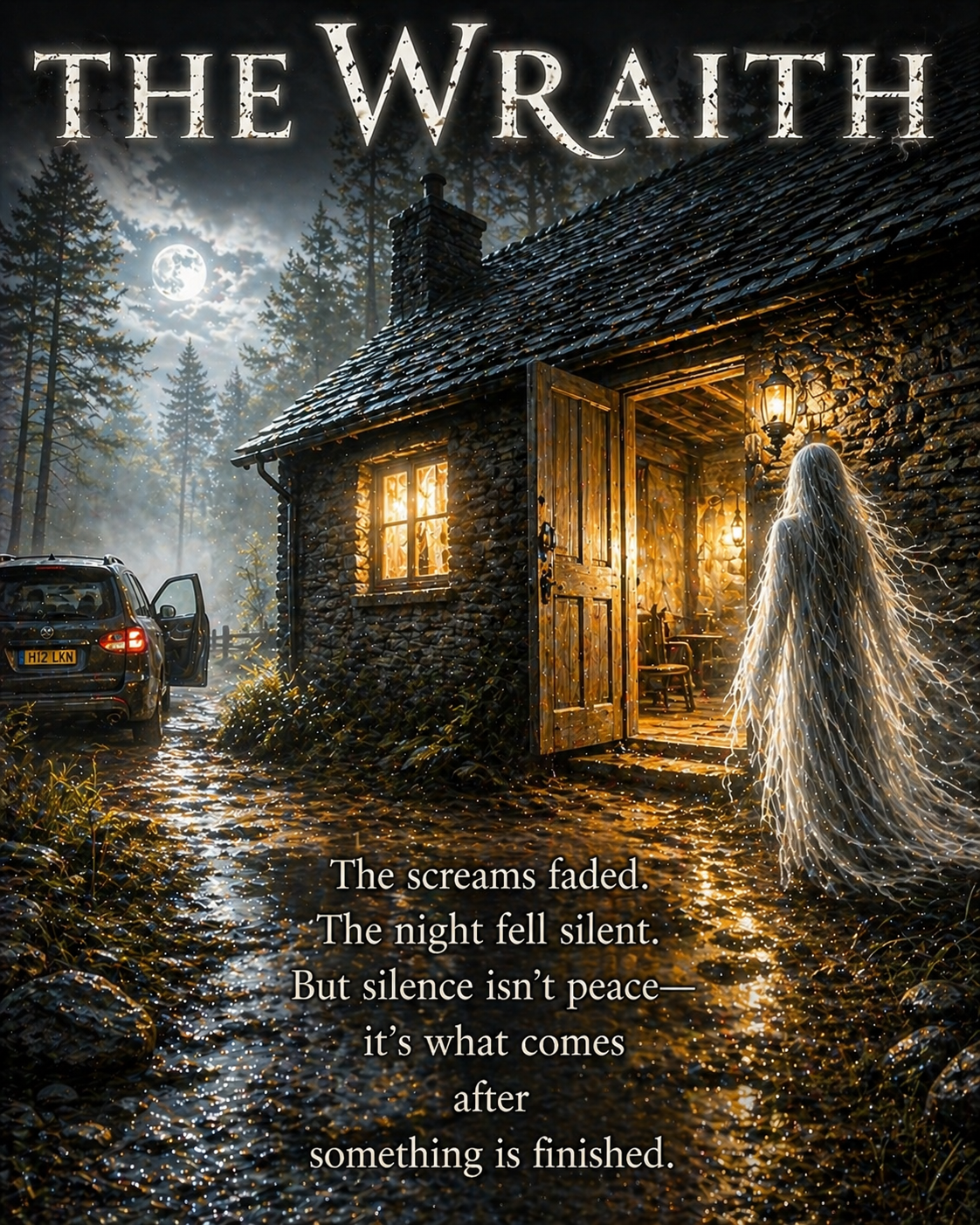
The nights are quieter now. The only noise to disturb the dark air is the hoot of the owl or the blood-chilling cry of the vixen. Annie and Dora still sleep, and their grave is tended and watched over. The house reverted to Emily after Liam’s freak accident, and with the help of Cora, Marie, and an assortment of nursing staff; it is now a retirement home. Its occupants the inmates of Hillcrest enjoy a freedom denied to them for so long. Between them they have restored the gardens. Marble statues appeared, haphazardly dotting the ground, when the trailing vines were stripped back. Everything was cleaned and polished, giving a sense of renewal. The old take pleasure in Laura and Shelly’s childish chatter and they in turn, love their newly acquired grandparents. They sit together at night and swap news, the two young girls just beginning their life, the others contemplating the end, but safe and content at last.
Still, there are times, when the dark closes in and the house lays quiet, when Cora stands at her window and watches. She looks across the gardens at the statues glowing white in the moonlight and standing like silent sentinels over the grave and wonders how long the peace will last. The red band on her wrist, burnt there by Annie’s hand, shows stark against the whiteness of her skin, and is a constant reminder of the eternal battle she witnessed. She traces her finger along the mark and her mind strays back to the day of Liam’s funeral. Many dismissed her lack of emotion for shock and her sob one of anguish, on seeing Liam’s latest pillow friend. They tut-tutted and whispered about bad taste, but Cora cared nothing about social niceties. What caused her to cry out was the unmistakable bulge in the front of the woman’s coat?
For the first time Cora did not think of the presence of the workmen as an intrusion. It felt safe having so many men about the place once the children were dropped of at school. They were over their fright. Shelly seemed to have forgotten it altogether. Laura was quiet, but this was not unusual, and she had leaned over from the back seat of the car and whispered. “Don’t worry, Mam. Nothing in the house will hurt you. I promise.”
“I know, darling,” Cora tried to smile, and she shook her head in wonder, as she watched her daughter’s retreating figure. Laura was at times, so much wiser than she was.
Work began on the kitchen. The huge dresser was wrenched from its place in the wall. It took six men to shift it, and she listened to their muffled shouts and curses, as the thing refused to come free. There were loud thuds and splintering of wood, as they broke the shelves apart. She liked the dresser and the blue china on its shelves, but Liam declared it too old fashioned for the ultra modern monstrosity he envisioned in its place. Still, she managed to salvage the china, and it was stored away in the attic and safe from Liam. She was busy ironing when she heard her name being called. John, the foreman, came into the room.
“Missus, you have to come and see what we found.”
Cora followed him back into the kitchen to find the rest of his men struggling to open a door hidden by the dresser.
“It must be a cellar of some kind,” John said.
The door gave way, the lock snapping with the force of the crowbar they used. Dust from centuries past, flew around the kitchen. The men waved their arms around, cursing and running to open windows. Only Cora remained unmoved, staring into the dark tunnel beyond the door. John, spluttering and fanning his face, shone a torch into the gloom.
“Aye, an old wine cellar or storeroom. There’s a stair leading down, but we’ll let the dust settle before we go down.”
Cora nodded and turned to go back to her ironing.
It was easy to tell when lunch time approached. The trucks started up again and roared away, packed to capacity with men eager for a pint. They would be gone for two hours. Liam stressed they were never to take more than an hour, but they were a law unto themselves, and she knew any protest on her part could lead to a downing of tools. Anyway, she smiled, what harm did it do? She liked these men with their simple lives and the way they came back bright eyed and laughing from the pub. Their language reduced her to tears of laughter on many occasions, and they knew she was not a snitch and unlikely to tell on them. Her husband, that bastard, as the men referred to him, was another thing altogether. A beggar on horseback, they sneered behind his back, and there was no mistaking the dark looks they gave him.
She smiled, as she sorted the clothes in the airing cupboard. The telephone rang and she ran down the stairs to answer. The number of Liam’s office showed on the answering system, and she drew her hand back in alarm. Finally, it rang off, and she heard the whirr as it recorded his message. The red light blinked, and she reached out and hit the play button, drawing her hand quickly back as though it would bite.
“I hope you’ve thought long and hard about out conversation of last night. When you are ready to do as you are told ring the office; they’ll arrange flights and accommodation for you.”
That was all he said, one chilling command to kill her child.
“Bastard,” Cora muttered, unaware someone else heard every word.
She went into the kitchen to make a hot drink, to thaw the ice that formed inside her. It was then she remembered the cellar door. John left his torch on one of the worktops. The beam was powerful, when she flicked the switch; it lit the wooden staircase to the bottom. She placed her foot on the first step and pressed down hard. It seemed solid, so she tried the next step. There was a crude banister on one side, so she held onto this. Soon she was at the bottom of the steps, and she swung the light around the room. There were candles set in holders around the walls and she ran back upstairs to fetch a lighter. On her return, she placed the torch on a table and lit each one. The room glowed to life, and she saw she was in an old cottage. The door and windows were bricked up, but there was no mistaking what it was. A large open fire took up most of one wall and it was set for lighting. The kindling turned to dust when she touched it. She walked around the room, stopping now and then to admire the carving on the handles of the chairs. A small dresser held bowls and cups, and she opened the doors on the press beneath it and gasped at the assortment of jars and bottles. Each one was carefully labelled with the name of the herbs inside, although the contents were reduced to powder or slime in their long wait.
There was another door in the wall, and she walked towards it. The handle groaned, but it opened easily enough. The odour of neglect was overpowering, and there was something else. Cora sniffed the air. Flowers, it smelt as though flowers were blooming somewhere in the room. There were more candles on a small cabinet, and she lit these. It was a bedroom. The bed made as though waiting for its owners return. Two dresses lay spread across the patchwork quilt, and she picked each one up and studied it. The first was made for a small child, the second for an older one or a young woman. Beside each one was a pair of beautifully embroidered slippers, yellow now from age, but nonetheless beautiful. What was this strange place, she wondered? It was like some enchanted cottage, suspended in time. She was not aware of the figure standing beside her, wringing its hands.
Annie had no intention of frightening the sad woman who roamed around her old home. It was the sight of Dora’s dress and the slippers. She knew Rose made them, and it rendered her heart allowing a sob to escape.
Cora spun around, her hand to her breast, eyes wide in terror. Annie drew back towards the stairs.
“Oh, God,” Cora asked. “What is it?”
“I am sorry.”
She tried to see where the voice was coming from. The candles made the room as bright as day, but there was nothing visible. Yet the words made something within her stir, and she managed to ask.
“Who are you? What are you?”
Annie stood at the end of the stair, wiping away her tears with her long hair.
“I am lost,” she cried, before drifting up the stairs and out of the house.
Cora tried not to scream, as the voice faded away. She managed to stumble up the stairs and stagger to the kitchen table. Realising she still held one of the slippers, she shuddered and threw it away. Her stomach lurched, more from terror than nausea, as icy fingers ran down her back. The door to the hall was open, but she was too afraid to walk through it. The workmen would be back soon. Once she heard their chatter the terror would abate.
The house groaned and sighed all around her. The rushing of water through the overhead pipes became a torrent. She heard the floorboards expanding and settling. Small scratching of mice behind the walls, made her sob out loud, as she imagined nameless things lurking there trying to pick their way through.
The thundering of the trucks on the gravel outside did not bring with them the respite she hoped for. The loud voices of the workmen set her fragile nerves even more on edge, and she clawed at the table for support as she waited for them to appear.
“What the fuck happened to that?”
She held her breath and listened to the grumbling from the hall.
“Missus,” The foreman came through the door, mouth agape and pointing behind him, but he stopped when he saw her.
“Are you alright, Missus?”
“I’m not well,” she managed to say.
“Let me help you.”
She felt his arm go around her waist as he lifted her to her feet, but she slumped and almost fainted, so he was forced to pick her up.
“Run on ahead and open the bedroom door,” he called to one of the workers.
Cora felt the cool air from the hall door as he swept past it. The other men stood watching as he carried her up the stairs. She thought their looks of dismay were for her condition, until she noticed the wall. The expensive paper Liam had chosen was reefed. Four lines, like nails marks, but scorched on either side, ran the length of the hallway. She fainted then, and was unaware of anything, until a glass was held to her lips and she gagged on the brandy.
She was lying on her bed and covered by the quilt. John, the foreman, was trying to get her to drink, but she pushed his hand away.
“I’m pregnant.”
“Come on now,” he pushed the glass towards her. “Something gave you a bad fright. A small drop won’t hurt the baby.”
“No, really. I’m all right.”
He put the glass on the bedside table.
“Would you like me to ring your husband?”
“No, really, I just felt faint. I’ll be fine in a moment.”
He nodded and looked around the room, in no hurry to leave. Finally, he asked.
“You saw the cottage?”
“Yes.”
“What do you make of it?”
“I don’t know. Have you ever seen anything like it before?”
“No, but I heard stories.”
“What kind of stories?”
“Ah, it’s mostly old drunken ramblings.”
“You mean, in the pub?”
“Yes, there’s not one who doesn’t have some kind of tale to tell about this place.”
“Tell me,” she begged, and motioned for him to sit on the bed.
“I’m not sure your husband would welcome me telling you of such things; not in your condition.”
“Please, I have to know.”
“Well,” he sighed, running a hand through his greying hair. “It’s like this. They say the old woman who lived here was guarding something. That she was, what was it they called her?” He rubbed his forehead, trying to remember. “A sentinel, that’s it, and now she’s gone there’s no one to keep it in check; whatever it is.”
“Whatever scraped the wall,” she whispered. “And whatever it was I heard it crying.”
“I can vouch for the wall,” he got up. “And I hope to God I see nothing else while I’m here.”
Cora pulled the quilt closer as she thought of the tombstone, the two dresses and the ages of the girls. She did not realise he had stopped and was watching her from the open door.
“They say she should never have been made to leave this place; that your husband sent away so he could get his hands on the house.”
“Then she’s still alive.”
“Aye, so they say, and if I were you, I’d find her.”
Marie Walters’ sighed as she picked up the phone. It rang relentlessly all morning and she felt a dull ache at the back of her neck; a sure sign one of her headaches was starting up.
“O Brien and Costello,” she spoke automatically into the receiver and was startled by the urgent voice on the other end of the line.
“Marie, its Cora O Brien. Do not say anything. If my husband is in the office just hang up and ring me later.”
Marie looked towards the open door of Liam’s office.
“Yes, I understand. Thank you for calling,” she said, replacing the receiver and making pretence of writing in the appointments book.
She tried to get back to work, but her mind kept straying to the urgency in Cora’s voice, and she wondered what she could possibly want from her. They were not on friendly terms, far from it. The only time she had met Cora was at one of Gerald’s parties. A sweet, shy woman, who seemed best left to herself. Still, living with Liam was bound to have a bad effect on anyone. She fluffed at her newly coloured, short hair and smiled. For the first time in years she had a date. The dapper gentleman from the pub sought her out. At first, she was outraged by his boldness, but she soon realised he meant no disrespect, and she had eventually agreed to walk out with him. He was, after all, a man with the same old-fashioned values as she was brought up to believe in. They would get along quite nicely.
“When you’re finished preening.”
She looked up at her employer and tried to keep her voice from shaking.
“Sorry, I didn’t hear you.”
“That’s obvious,” he glared at her with contempt. “Is your hearing going along with everything else?”
“What can I do for you?” She asked, refusing to let him upset her.
“I’m going out. You should be able to manage without me.”
“Of course.”
Once he was gone, Marie turned to Rachael.
“You said something about needing to do some shopping?”
“Yes, I could do with an hour to get some things I need.”
“Then go now, while he’s away.”
Are you sure?” Rachael asked, already reaching for her bag and coat.
“He’ll be gone for hours,” Marie assured her.
“But what if I should run into him?”
“Tell him I sent you out for some stationery.”
“Thanks, you’re a doll.”
Once Rachael left, Marie picked up the receiver and dialled.
Cora, who was waiting in the study, answered it at once.
“Oh, Marie, thank you for calling back. I’m sorry for sounding so hush hush about this, but I need your help.”
“If there’s anything I can do to help I will,” Marie assured her.
“You’re very kind and I really do…” Cora’s voice became choked with tears, and it took her a moment to steady herself. “I’m sorry; it’s been a trying day.”
“Take your time, dear,” Marie said, feeling sorry for the young woman, who was obviously in distress.
“You know we moved into an old manor house?”
“Yes, dear.”
“Well, I was wondering if you could tell me who lived here before us?”
There was silence at the other end of the line.
“Marie, are you still there?”
“Yes, dear, just give me a moment,” Marie answered. Her hand was trembling so much she found it hard to hold the receiver. She remembered the last owner all right. The little old lady Liam had committed to a home, after taking over as her solicitor and making her sign power of attorney to him.
“Marie?” the hesitant question made her take control.
“I’m sorry, my dear. I was trying to recall who had lived in your house. It was an old lady. A Miss. James I think her name was.”
“Do you know what happened to her?”
“She was put in a home.”
“Put in a home, was she insane or something?”
“No, dear, just old.”
“So, who put her there, a relative?”
“No, not a relative.”
“Then who?”
“I’m afraid I can’t answer that.”
There was silence on both ends of the phone for a moment.
“Marie listen,” Cora pleaded. “Strange things are happening here, and I’m frightened.”
“I’m sure if you ask in the village someone will know the house’s history.”
“No,” Cora almost screamed. “I need to speak to the last owner.”
“I’m sorry, my dear, but I can’t help you,” Marie went to replace the receiver, when the sobbing stopped her. She listened, not knowing what to say.
“I’m pregnant and he wants me to kill my baby.”
“Oh, no,” Marie gasped.
“Sometimes I feel as though I’m going mad, and now this thing with the house,” Cora’s voiced trailed off into muted sobs.
Marie thought about Gerald and his fatherless children. Liam O Brien cared nothing for them and even less for his own.
“He keeps papers in the safe in his office,” she said. “I have the key. I’ll try and make copies for you, but you’ll have to meet me.”
“Yes, anything.”
“He’s out now and I’m alone, but it’s too risky, as I’m not sure when he will be back. Give me a few hours and I’ll call you back.”
“Thank you, Marie. You don’t know how much this means to me.”
Or what it means to me, Marie thought after she hung up. She had seen the many countless acts of cruelty and corruption instigated by her boss. Now it was time to turn the tables on him. There was the risk of losing her job and in the past, it would have terrified her, but not now. She thought of her date that evening and knew her life was changing for the better.
“I’m back,” Rachael breezed in, loaded down with shopping bags. “Did I miss anything?”
“No, nothing,” Marie said, and watched as the girl hid the bags beneath her desk.
She waited, as Rachael recounted her purchases and nodded and smiled, in what she hoped was the right places, as she heard none of the girl’s words. Her mind was too caught up in what she was about to do.
“Rachael,” she finally asked. “Will you do something for me?”
“Sure,” the girl shrugged, expecting to be asked to make tea.
“I have to get something from the safe in O Brien’s office and I will need to make copies.”
“Yeah, okay.”
“The thing is. I need you to act as lookout.”
“Sounds serious,” she stuffed a piece of gum in her mouth and waited for an answer.
“It is. It is something I am doing for a friend. Call it righting a wrong.”
“Okay, what do you want me to do?”
“Watch the street. If you see him coming call me.”
Rachael swung round in her chair and propelled herself towards the window. The sound of the chair’s castors on the bare floor sounded like a scream in the quiet of the office, and Marie felt the familiar throb in the back of her neck. Rachael eased the window open and leaned out to get a better look.
“Go on,” she waved at Marie.
The interior of his office seemed darker than usual, and the smell of his cologne hung in the air. Marie eased open the top drawer of his desk and located the bundle of keys inside. She flipped through each one on the ring until she found the one, she needed. The safe was behind an old panel in the wall and she pulled this open. Her hands shook, as she turned the key and the thunk of the lock opening made her jump. There were bundles of letters and documents inside, and she laid these on his desk and started to rifle through them. She was sweating and she wiped her hands on her skirt, afraid she would leave tell-tale finger marks.
“He’s driving up the street,” Rachael called, just as the envelope Marie needed came into view.
She gathered the rest of the papers together and replaced them carefully in the safe and was sitting at her desk writing, when he came into the office. He ignored them and slammed his door shut behind him.
“That was close,” Rachael whispered.
Marie nodded, too winded to speak. It was not until Rachael and Liam left for the day that she picked up the phone and dialled.
“I have the papers you need. Do you know where I live?”
“No,” Cora said.
“Very well,” Marie listed off her address. “I can’t meet you until tomorrow night. I have an engagement tonight.”
That is a pity, but I’ll have to wait.”
“I’m afraid so, my dear.”
Cora stayed looking at the receiver long after Marie had hung up. She could hear the children squabbling upstairs and they would soon be demanding their dinner. Liam would not be home; she was sure of this. If she had money they could go to a hotel, but Liam kept her short and paid for most things. She could not risk asking anyone for help, as he would use this to his advantage in proving her mentally unsound. So, she would be forced to spend another night alone with the children, and praying for her sanity.
Her body continued to burn throughout the day. The sight of her smouldering corpse met Meg and Pat when they rode into the village that evening, and it was one, they would never forget. Annie’s blackened figure hung amid the embers of the fire. The spear held it in place.
The children were asleep in the back of the cart and spared the terrible sight, but Meg and Pat were inconsolable. A shadowy figure moved from the shelter of the mill and stumbled towards them.
“I threw the spear,” the young guard sobbed.
“You…” Pat cried, catching him by the throat.
“I had to; she was cursed to feel each flame.”
Pat looked at him uncomprehending, and it was only when Meg pulled at his arm, he released the boy.
“Let him be, Pat. He put her out of her agony.”
The boy coughed, rubbing at his bruised throat.
“I worked all day putting the fire out.”
“Where is he,” Pat asked. “This man, Tanas?”
“He disappeared before she died.”
“And the O Brien’s and the rest of the village?”
“They fled in terror.”
“They will have more to fear than the Devil when I find them.”
The sound of Meg retching made them run to her aid. She could no longer bear the sight of the burnt corpse, or the smell of cooked meat pervading the air.
“Take us home,” she beseeched Pat. “Take us to Annie’s cottage.”
“She will need a Christian burial.”
“You can come back when the cart’s unloaded and bring her home. The embers are still too hot and there is no hurry now. Just take us away.”
She had to be lifted onto the cart. The very life seemed to have drained from her, and she sat in a stupor for the rest of their journey.
The cottage looked dark and deserted. A melancholic breeze sighed among the trees. Even the little pool beside the cottage was covered with green slime. Nature itself mourned the passing of one so good.
The sleeping children were carried inside and put to bed. Meg took some wood from the stack beside the hearth and lit a fire. Even its comforting light did nothing to dispel the gloom. Pat brought water from the well, filled the kettle and swung the arm over the fire.
“I will make you some tea.”
Meg slumped into a chair and watched the leaping flames. Pat realised, for the first time, how old and frail she really was. They sat in silence until steam hissed from the spout, and the water threatened to boil over.
“My God, my God, why hath thou forsaken me?”
The hair on Pat’s neck rose at her whispered question, and he gulped back the tears. This was his fault; he knew something was brewing.
“You are not to blame.”
Her words startled him.
“Sit down,” she pointed to the chair opposite hers.
Pat handed her the tea and sat down. He was glad of the solidness of the wood beneath him. It was the only thing that seemed real. He held the cup with both hands to bring it to his lips, and he noticed how Meg’s hand trembled also.
“This is not a time for blame,” her eyes seemed to bore into him. “Nor a time for revenge.”
“I do not understand. What happened?”
“Annie, Lord rest her soul,” Meg continued, then stopped suddenly as the sound of the familiar name pierced her heart. She allowed the cup to slide from her grasp and it shattered on the stone floor.
Pat could do nothing to help. The tears that were threatening spilled over, and he was forced to hold a hand over his mouth, least the sound of his anguish wake the children.
“Come now,” Meg managed to rouse herself. “There is much to be done and plenty of time for grieving in the months ahead.”
Pat wiped the tears from his face.
“Take your cart to the store and unload it, then bring Annie and Dora home.”
“Dora?”
“Dora is dead. I felt her spark die before Annie’s.”
She rose and motioned him to do the same. He was afraid to leave her alone and told her so, but she knew the danger was past. The Dark One was vanquished. There was nothing left for him there.
The young guard was keeping watch over Annie’s body, and it was with his help, Pat managed to take her down. She felt warm to touch, and he moaned when he realised the pieces of ash falling from her was skin. They placed her in a blanket and loaded her onto the cart. Still the village lay in silence. No dogs barked; no lights showed in any of the windows.
“There was a child, a little girl…”
“They buried her outside the chapel wall,” the guard told him. “I can show you where.”
Pat led the horse along the village street. The sound of its hoofs shattered the quiet. Clip—clop, they rang through the silent night.
It was easy to find the small, unmarked grave. Burial outside the chapel walls was a fate reserved only for suicides, witches, and stillborn babies. The guard went inside and returned with two spades, the property of the gravediggers. Dora was not buried very deep, and the earth was dry and easy to dig. She was wrapped only in a blanket. Pat threw this aside and cried out when he saw the condition of her body. The stench made him draw back and he gagged at the raw, rotten smell of her decay. When he lifted her from the dank earth, her hair that was hiding her face, fell back, the moon lighted upon her, and he gasped at the beauty and serenity of her features. Despite the marks on her body, death left no sign of suffering.
The young guard, who introduced himself as Tom O Shea, offered to make the coffins and help with the grave digging. Pat accepted with a nod, and Tom climbed up onto the seat beside him. Meg came out to meet the cart. Pat stopped her from pulling back the blankets shrouding Annie and Dora.
“It is best to remember them as they were.”
They spent the rest of the night in the woodshed fashioning makeshift coffins from pieces of timber.
At dawn they buried Annie and Dora side by side, in the farthest corner of the property. A light rain fell as Pat and Tom filled the hole. A wind blew up, and it seemed as though the trees were bowing over the grave; paying homage to one who was a part of the forest.
“Should they be in consecrated ground?” Pat looked at the mound.
“Anywhere she lies is blessed,” Meg wiped her tears and turned to go. “The children will be awake soon and there is a lot of explaining to do.”
It was a solemn procession that walked back to the cottage that morning.
Meg, Pat, and the children stayed on at Annie’s cottage. More rooms were added to make way for the growing children. Pat’s business prospered, though it was whispered he was never the same after Annie died. Meg did her best at being mother to Rose, Paul, and Lily, but the loss of her loved ones took their toll. She spent hours beside the grave each day talking and whispering about old times. Flowers grew in abundance and covered the mound watered by Meg and Pat’s tears.
Slowly the seasons passed, and it was soon winter again. The sky was dark with the promise of snow when Meg set off to collect kindling from within the forest. There was no need for her to do this, as Pat had a woman come in and help with the housework, but it kept her busy and her mind from tormented thoughts. It was reported Mary O Brien was dying. Some said it was from a broken heart, but Meg knew it was from vexation.
The holly bushes were heavy with berries, a sure sign of a hard winter. Lord, I am tired Meg thought, as she stooped to pick up a stick. A cold wind stirred the trees above her, and she gathered her shawl tighter and was about to turn for home, when she heard it, a long, mournful cry that froze her blood. Meg listened as its volume increases and tore at her heart.
She allowed the sticks to fall, as she followed the sound. It took her way beyond the forest and into the village. Every window and door were locked, as the villagers tried to escape the cry. Her search took her to the O Brien’s house, where Hugh’s ashen face appeared at the window. Annie stood in the garden; Annie as beautiful as she had once been. The wind whipped her hair around her and carried her cries with it. Those who heard it would describe it as a keening, a ghostly lament for the dead.
Annie, Annie child,” Meg leant on the gatepost, her eyes blinded by tears.
“Do not come near me, Meg,” Annie sobbed, her cries rising and falling. “I am cursed to walk the earth until the end of his line.”
“I will find a way to help you, child,” Meg walked towards her. “Let me take you in my arms.”
“You cannot, Meg. You will die. I am death to all who touch me.” Annie floated towards the house and sat upon the windowsill.
Her crying continued unabated until dawn. Meg sat on the steps to the house praying and never taking her eyes from Annie’s face. The sounds she made were frightening, and Meg prayed, asking God for some relief for the child. Snow began to fall at first light. Soft flakes at first, but it soon came faster swirling about the village, covering everything.
“I have to go,” Annie called to Meg. “She is dead.”
“Where will you go?”
Annie’s eyes opened wide in terror. “I belong to the night. I lie shrouded in darkness. Help me, Meg.”
Sheets of snow blinded Meg, as she fought her way towards where Annie sat. But she was gone, fading into the air. The last thing Meg heard was her crying. “It is not fair; I am so frightened. Help me, Meg.”
Meg groaned and rubbed at her aching back. The two nights they spent within the forest were cold and her old bones ached from sleeping on the hard grass floor. The weather stayed fine, but the early morning frost froze them to the marrow. Their only shelter was a crude canopy of leaves and fallen branches that did little to protect them from the cold. The children, as in all times, adjusted well, though Rose was quieter than normal. Her mind was filled with worry about her sisters. Meg tried to assure her they would be all right, but the words were stilted. For she heard a death cry carried on the breeze, its sound clear as solemn church bells, tolling through the quiet of the night.
Meg picked the last of the autumn berries from the bushes. These would have to do for the children’s breakfast. The food she packed was soon eaten and they had to resort to what they could forage from the forest. The children slept on and she was loath to wake them, but the sun would soon be up, and the open road called to her. The sooner they found Pat, the sooner they could rescue Annie. She would not think about the cries she heard. There could be many explanations for the sound, but still…
The children woke shivering, and the handful of berries they received did little to lift their mood. Soon they were on their way. As always, they kept within the forest. By now they were clear of the village and the rumoured roadblocks proved to be just that. No one tried to stop them, and the road remained bare with no sign of passing traffic.
Meg felt weary. The last few days were the hardest she had ever known. But it was not just the tiredness of old age that bothered her, but the weariness in both heart and soul. She felt the evil all around her. The air felt cloying, and at times, it seemed as though she was walking through a thick fog. The Dark One was working his evil, trying to delay her.
The forest was dark, despite the many fallen leaves. The bare branches seemed like skeleton arms that might reach down at any moment and pluck her from the earth. Shadows darted among the trees and strange creatures seemed to keep pace with them as they walked. There were indistinct cries and growls from far away, and she blessed herself and mumbled a prayer for protection.
They walked until the sun was well up, and now the children were tired. The bank of a stream proved an ideal resting place, and Meg dipped her handkerchief in the water and rubbed the stains of the blackberries from the children’s faces. She eased her way down onto a rock and watched as they played. They would soon be complaining of hunger. The air was much fresher here and the birdsong relaxed her. Her mind filled with thoughts of Annie and Dora and she swallowed hard, fighting back tears.
Sudden squeals and shouts from the children roused her. Paul was swaggering towards her with the body of a rabbit held aloft. He, like many of his kind, was a skilled hunter. His snare worked within minutes, and he beamed with pride at the look of relief on Meg’s face.
He cleaned and skinned the rabbit, while Meg lit a fire. Soon the smell of roasting meat made their stomachs rumble, as Meg turned the makeshift spit. Each thought the meal of roasted rabbit and water from the stream was the best they had ever had.
It was a much livelier group that set off that morning. The feeling of oppression lifted, and even Meg’s back did not ache as much. Rose and Paul carried the magpie, that cawed in annoyance, when they swung the basket. The sun, though watery, warmed them and their clothes soon lost their dampness. The meal they had just eaten would keep them going for most of the day. Meg would not have to worry until nightfall.
“Meg help me” the sobbing seemed to come from all around her. She spun, trying to find the source. The forest lay in stillness, and she held her breath. Her heart pounded against her breast when she heard the menacing laughter and Annie’s screams. “Oh God help me, Meg. I am in agony.”
Meg stumbled to a tree trunk. The very breath was taken from her body. Annie was in terrible pain. Dear lord, Meg prayed, take me, leave the child be. There was no answer, just the sighing of the leaves.
“Meg,” Paul came crashing through the undergrowth. “Come quickly. There is a cart coming.”
The children were hiding behind the trees, watching as the cart and driver approached. The wheels thundered on the rough track, as the driver whipped his horses onwards. It was almost upon them when…
“Pat, it is Pat,” Rose ran from her hiding place and waved her arms at the approaching vehicle.
The horses whinnied and snorted, as he pulled tight on the reins. Clouds of dust rose into the air, driven there by the skidding hoofs. Pat’s look of surprise on seeing Rose was soon replaced by fear, as Meg came walking towards him. Without waiting for an explanation, he lifted the children onto the back of the cart and helped Meg to climb up beside him. He flicked at the reins, and they set off. Meg whispered to him, as they rode, not wanting the children to hear. His eyes opened wide in alarm at her news.
“I knew something was wrong,” he whispered, shaking his head, and spurring the horses onwards. “I will kill those O Brien’s. So, help me.”
“They are in the grip of The Dark One.”
“What do you mean?”
“The very Devil himself is among us,” Meg crossed herself. “He has taken the form of a man.”
Pat’s head was reeling. It had to be that Tanas fellow. He was the only stranger in the district.
“We will save them, Meg,” Pat’s strong hand closed over Meg’s own and she held on tight, drawing strength from his touch.
“I pray to God we can. That we are not too late.”
Annie was forced up from the straw. She cried aloud as a dress was pulled over her head and scraped over the scars on her back. Her toes dragged along the stone floor, as they half-carried her. Some of the cuts opened from the rough handling, and she left small drops of blood in her wake. The jailors jeered at her shorn head.
A wave of noise erupted, as she was taken from the mill. Her death was to be a great occasion. The sunlight stung her eyes, as she had become used to the dark, and the many figures before her seemed faceless. Some laughed and pointed. Children ran towards her, wanting to touch the witch. Annie kept her head bowed and allowed her eyes to adjust.
The first thing she saw was the wood. For a moment she thought she was at the steps of the gallows, but when she allowed her eyes to travel upwards, she saw this was not the case. A stout pole stood in the centre of a woodpile. The villagers were still adding to it. The procession stopped, and she looked around at the people who gathered. Many of them were old friends of her family, and she tried to make eye contact.
“Well, Mistress Ryan,” The Dark One walked towards her. “It is time to pay for your sins.”
“I am innocent,” Annie cried, and this drew mumblings from the crowd.
“You are the leader of the witches and you must pay,” he snarled, and leaning closer whispered. “Unless you have changed your mind?”
Annie shook her head.
“Take her up.”
Annie was forced towards a ladder on the side of the pile. She stumbled on the rungs and was carried up by one of the guards. They tied her to the stake and wound strong chains around her body. Her hands were tied behind her back, so she was forced to look at the crowd. A shout of “silence” rang out and an uneasy hush fell. Then, The Dark One spoke.
“A witch with power as strong as Mistress Ryan must be burned; the fire will nullify all her evil.”
“No,” Annie strained against her bonds. “I am not a witch. Help me.” She looked at Mary and Hugh who stood at the end of the woodpile. “Mary, for the love of God, tell them I am innocent.”
Mary shrugged and Hugh smiled and winked at her.
“Bastards,” she screamed. “It is you who should be in my place.”
“Enough witch,” The Dark One motioned to the guards.
There were four men in all, and each held a torch of blazing pitch. At his signal, they threw the torches into the piles of branches and shrubs between the timbers. The dry kindling caught fire instantly. Flames crackled and leapt to other branches.
“There is plenty of green wood beneath,” Annie heard Hugh’s voice above the noise.
She knew the green wood was damp and would take longer to burn. She would suffocate. Amid the haze of acrid smoke, The Dark One appeared. He seemed to be hovering above the ground. The crowd drew back, some crying, others screaming in fear.
“I will ask you once more. Denounce your God. Give me your power.”
“Never,” Annie managed to croak.
“Then I curse you,” his voice sounded like thunder. “You will die, but you will never know rest until the last male in his line is gone,” he pointed towards Hugh.
The flames were licking about her toes and she tried to draw up her feet as he continued.
“You will feel each flame. You’ will not die until the fire reaches your heart.”
“If that be the case,” she gasped, the smoke stung her throat. “My voice will be the last one the O Brien’s ever hear. I swear this by all that is holy.”
Most of the crowd ran away. But the O Brien’s and the guards all heard her words. Mary was carried away in a faint. Not only had Annie’s curse upset her, but also the sight of her intended husband levitating above the ground before disappearing was too much.
She was not there to hear Annie’s screams as the ends of her dress caught fire and the flames scored her skin. Neither did she witness how the flesh on her feet turned black, as the toes curled upwards.
“Help me Meg,” Annie cried. “I am in agony.”
Even the guards took flight at this, and she was left alone to burn in the still morning air. She screamed and writhed against the chains. The flesh on her legs melted exposing the bones and sinews. The flames continued upwards leaping towards her face.
“Oh, Jesus, Miss.”
Annie saw a shadowy figure running below her.
“I will get water,” the young guard shouted, and in seconds the flames hissed, as he threw water on them.
. The fire burned fiercely.
“Let me be,” she screamed. “I am destroyed.”
He continued to throw buckets full of water towards her. The flames died in places, and she was able to see him.
“Look, look at me.”
He stopped and looked up at her. His face was blackened from the smoke, and there were tracks where his tears flowed. He saw the flesh was burnt beyond repair. Blood and fat dripped from her fingers.
“The Dark One cursed me. I am to feel each pain.”
He shook his head before running away. Annie moaned and arched her back, as the flames reached her thighs.
“Close your eyes Miss,” she heard him call. “It is all I can do.”
His aim was true, and the spear pierced Annie’s heart. She gasped, and her eyes opened wide for a moment. Then she smiled at him, before her head fell forward.
Meg shivered and hugged her shawl closer to her thin shoulders, hoping to find warmth within its folds. But, in truth, the cold seemed to emanate from within her. She got up, and taking the steel poker from beside the hearth, stirred the dying embers. She watched and waited all through the night. Now, it was almost dawn and still there was no sign of Annie. The children had not slept well, especially Dora, who cried out numerous times during the long, cold night.
Walking to the window, Meg opened the shutters. She would wake the children at the first sign of daylight. The forest lay shrouded in mist, and the trees that once seemed like friends, now towered over the small cottage, menacingly. Their dark shapes a hiding place for any watchers. She shivered again and admonished herself for such foolish thinking.
Throwing open the door, she stepped outside as the first rays of light were filtering through the branches. The forest lay in a deep stillness. Meg held her breath and listened for the usual sounds that heralded the start of each new day. There were none, even the birdsong was missing. She walked to the small gate dividing her home from the forest and laid a trembling hand on the lichen-covered wood. Moving her head from left to right; she strained her ears trying to pick out any sign of life. There were no scurrying shapes in the hedgerows or sounds of animals foraging for food, nothing, just the sound of her own breathing. She was about to turn back towards the cottage when she heard it, an indistinct cry from far off in the forest.
She spun on her heel, almost tripping over her skirts in her haste. Walking as quickly as her aching back would allow, she went to the children’s room and woke them. They fussed and groaned at being woken so early, but she ignored their pleas of “just a few more minutes” and dragged them from beneath the covers. They stood for a moment rubbing sleep from their eyes, and Meg shouted at them to put their shoes on. As usual, she allowed them to sleep in their clothes, and it was only a matter of getting Rose and Dora ready. Lily and Paul, like many gypsy children, went barefoot. Not even the cold of the damp earth bothered them, as the skin on the soles of their feet hardened to form a protective barrier.
“Get your shawls,” she called to Rose and Dora. She had two knitted shawls lining her basket and these would do for Paul and Lily, when they started to feel the cold. Trying to make them wear these now would be a battle and only waste time. The children wandered in from the next room and stood bleary-eyed watching her.
“Take one each,” she pointed to the small, cloth-wrapped bundles of food she prepared during the night.
“Where are we going?” Rose’s eyes followed Meg, as she lifted each sleeping cat from its chair and threw it outside.
“We are going to the town to find Pat and bring him back with us.”
“But where is Annie. Why is not she here?
“She has been delayed, but sent a message saying we are to do as she asked and that is to go to the town.”
“Who brought the message?” I didn’t hear anyone.”
“A man. A man from the village came late last night. Now, will you do as I ask?” She pointed towards the waiting bundles.
“It seems very strange to me,” Rose scooped up her bundle and the others followed suit.
“Well, life can be like that sometimes,” Meg pulled the jackdaw from his hiding place and laid him in her basket. She knew he was helpless without the ability to fly and would fall prey to some animal. The cats and dog were natural hunters and they would easily find food.
“Come along,” she herded the children towards the door. “And not a sound now. I want you all to be quiet as a mouse.”
Rose turned a baleful eye at her.
“It’s a game,” Meg assured her.
“I have to use the pot,” Dora started to jump up and down, hands held tight between her legs.
“You can go in the forest,” Meg turned to close the door, but the child scurried past her and back inside the cottage, her voice echoing.
“I cannot wait. I will wet myself.”
“Christ give me patience,” Meg scanned the trees for signs of life.
Her heart was pounding, and her breath came in small gasps. Rose was watching her again. She had never seen Meg so upset and annoyed.
“Ready now,” Dora ran back out, and then realising she had left her bundles behind, ran back in.
By now Meg was on the point of screaming. But, finally, they were out among the trees and making their way towards the road.
“Stay well behind me,” Meg warned. “And not a sound until I tell you.”
They nodded and followed her in a line, each one more aware of how serious she was. She looked back from time to time to check they were all right. Her hip and back ached as she navigated the uneven forest floor, but it was her mind that was sorely troubled. The cry she heard was the voice of Annie, warning her to take flight. She could not be wrong, for she had felt in her heart the strangeness of the sound, and the stillness that followed, told her the child was in the gravest danger.
They were well clear of the cottage and hidden by the trees. Once they reached the road, they could walk through the giant ferns bordering it and remain out of sight. If quarantine roadblocks were set up, as it was rumoured, then they would return to the depths of the forest and get by them. She was so deep in thought, she failed to check on the children. Glancing over her shoulder, she saw Rose was right behind her, Lily and Paul were walking with their arms around one another whispering, but Dora. Where was Dora? She stopped so suddenly Rose collided with her. The jackdaw cawed loudly as she dropped her basket.
“What is the matter?” Rose asked.
“Dora, where is Dora?” Without waiting for an answer, she pushed by the children and searched among the trees.
“She was here a minute ago,” Rose’s eyes filled with tears and she tried to run back the way they had come.
“No,” Meg grabbed her arm. “I will go. I need you to look after the others.”
“I am faster,” she tried to wriggle from Meg’s grasp.
“I need you to do as I ask,” and taking her out of Lily and Paul’s hearing, she whispered. “Annie is in terrible trouble. The only one who can save her now is Pat O Mahoney. You know Pat, do you not?”
Rose nodded.
“You must go on without me, take them,” she gestured towards the others. “Find Pat. Tell him what I said about Annie. About her being in trouble, understand?”
“What about Dora?”
“I will find Dora. You must not worry about us. We will catch up with you later. Stay far away from the road; keep to the forest and out of sight. No matter what happens you have to find Pat.”
“I am frightened, Meg.”
“I know you are child, but you have to be brave, for all our sakes. There is enough food to last you and the trees will give you shelter by night.”
“You mean stay alone in the forest, at night!”
“There is nothing in nature that will harm you and anyway, I will probably be back with you by nightfall. Go now and God keep you safe,” turning to Paul and Lily, she ordered. “Do what Rose tells you and be good. I have to look for Dora.”
They nodded and exchanged furtive looks.
“Do you know where Dora is?”
“She went back to get Blackie,” Lily whispered.
“Go on,” she motioned to the children.
When she had walked some way, she turned and saw they were still standing, watching her. “Go on,” she called to Rose, her voice stern, so the child turned and continued her way with her two little charges trailing behind.
When she was sure they would no longer try to come follow her, she set off. Her back ached and she was limping from the pain in her hip. The basket weighed heavily, and she stopped and searched for somewhere she could safely leave it. The long dried-up husk of a tree proved to be the answer. It had been struck by lightening. The force of the blast struck even to the roots, and it now stood bleached white by the elements. Only two stout branches remained, one on either side. These were thrown up towards the heavens like arms spread-wide in bewilderment at what happened. A long-abandoned hollow in the trunk was a safe place to leave the jackdaw, so scooping him out of the basket, she placed him in the hole.
“You will be safe there until I get back,” she assured him and he cawed once fluttering his good wing in answer. The basket was hidden behind the tree before she set off once more. She moved a little faster now it no longer banged against her hip. Still, it took some time before the cottage came into view.
She approached it from the side and at first glance nothing seemed amiss. Fearing someone might hear, she had not dared, in all the time she was walking, to call out to the child. It was not until she reached the pathway and the little wooden gate, she saw the carnage. The bodies of her cats lay butchered in the grass. Their heads lay beside them, the fur matted with blood, mouths wide in a scream of pain.
“Sweet Jesus, protect us from all harm,” she spoke aloud as she crept towards the open door.
The interior was a shamble with every jar and bottle smashed on the floor. Even the rags she used as stuffing for the cushions was pulled out and scattered about. The air reeked of blood and excrement and she picked her way around the table in search of the source. Her old dog lay beside the fire and for a moment she thought he was sleeping. It was hard to make out in the shadowy interior, and she called to him in a whisper.
“Here dog. Good boy, come here.”
The closer she got the worse the smell became. Using the table as support, she reached out and nudged him with her foot. He never moved and she saw to her horror the toe of her shoe was stained black. Groaning, she eased herself down, holding one hand over her nose to block the stench and almost retched when she realised what she mistook for a shadow on the floor, was in fact a pool of blood. She reached out a hand and stroked the rough coat of the animal. The dog’s head fell to the side and she saw his throat was cut. Blood coated the hearth and sprayed up the wall; she saw also the reason for the smell. His muscles loosened in terror and the floor was covered in the waste that pumped from his body.
“I am sorry old friend,” she whispered, before leaning on the table, she managed to stand.
She was so caught up in the horror of it all, she forgot for a moment her reason for being there, Dora! She hurried towards the only other room in the cottage, the bedroom. This too was in total disarray, even the bedcovers were pulled free and the thin horsehair mattress split down the middle in the searcher’s fervency. But this was not the work of a man. No, this had all the marks of the beast and now, by all accounts, he had Dora.
She rounded the side of the cottage to her tool shed. There she picked up a shovel and carried it back to the front. Crying, she scooped up the bodies of her cats. A couple of times the heads fell off the shovel and she was forced to follow them, as they rolled along the path. Blinded by tears, she placed the cats beside the dog and taking a tinderbox from above the fire she walked outside. Lifting her skirt, she tore a piece from her undergarment. This she lay on the windowsill and struck the flint against the box until it sparked, and the cloth caught fire. She flung the blazing cloth on to the roof and within seconds the thatch was ablaze. Her animals were good and loyal friends and this funeral pyre was the only way she could repay them. She would never have returned to the cottage, not after what she witnessed. It was tainted by his presence, no longer holy ground. Things would be changed forever; she knew this as sure as she knew night followed day. The straw crackled and hissed in the quiet air. Small tufts flew from the roof and set the grass alight. She watched until the roof caved in and the small fires in the grass died down, and she was sure it would not spread to the trees. Something brushed against her skirts and she looked down in amazement at the black cat circling her legs. Bending down, she stroked the soft fur on Blackie’s head. He had somehow survived, and she called to him to follow, as she moved back towards the shelter of the trees.
In just over a day she lost her home, her child, for in truth Annie was as dear to her as any she might have borne, and little Dora. Her world was filled with wickedness and evil and yet there was no sign of the hand of God in all of this. Had she been right in her first assumption? Had the time come once again for a sacrifice and would it be, as always, the most precious and innocent of his children who would suffer the most?
She was crying in shock when she reached the lightening tree. Retrieving the jackdaw from his hiding place and set off in the wake of the children. The basket held firmly by her side and the small black cat running along beside her.
Annie spent three days nursing Jane and her children. The children recovered quickly. Jane, though still quite weak and depleted by her suffering, was no longer as helpless as she had been, and Annie was desperate to get home. She missed her sisters, and the worry of their absence was more draining than the actual nursing. Jane was sorry to see her go and there were tearful farewells and kisses before she managed to tear herself away.
It felt good to be back in the forest. The air smelt fresh and sweet and the birdsong lulled her as she walked. The soft muted trot of horse hooves upon grass made her turn, and she was surprised to see the Squire ambling towards her.
“Good day, Miss Ryan,” he raised his hat.
“Squire,” she nodded, as way of both greeting and farewell.
“Come now, Miss Ryan,” he rode up beside her, his boots almost flush against her face. “Will you not stop and pass the time of day with me?”
“I’m in a hurry, sir. I’ve been away from home these past four days, and I’m anxious to be reunited with my sisters.”
She reached out and pushed against the mare’s damp hair. The horse was so close she was afraid it would knock her.
“Then, I’ll walk with you,” he slid the foot nearest to her from the stirrup, and was about to dismount, when she managed to get past the horse.
“Don’t bother. I’m really in a hurry,” she was off and running through the ferns bordering the forest. She dreaded the Squire. At the last Harvest festival, she had to smack his face for being too familiar. He vowed revenge on her, but nothing was forthcoming. She told her mother all about the affair, and a look of fear had crossed her face, but this was soon replaced by anger, as she cursed his cheek at touching her child.
Annie was running as fast as the terrain would allow. She picked up her skirts and held the basket above the ferns to stop it snagging and pulling her back. It was slow going, and she was sweating from the effort, but terror spurred her onwards. She was still close enough to hear his parting words and though she did not turn around, she knew he was angry.
“Take care in the forest, Miss Ryan. It’s dark enough to hide the Devil himself.”
It was a relief to be free of the ferns and out among the trees. It was easier to run here, and the many roots and gnarled trees twisted by age, made riding dangerous. He would not dare follow her.
Dora was the first to see her, as she made her way towards Meg’s cottage.
“Annie,” the child hurled herself at her sister’s waist.
“Let me go,” she laughed, pulling free.
“Oh, Annie, I thought you’d gone away forever.”
“You silly goose. It has only been three days. You know I’d never leave you.”
“Swear,” the child looked doubtful.
“I swear. Cross my heart and hope to die.”
“Oh, no, Annie please do not.”
“Don’t what?”
“Don’t hope to die.”
“Then I won’t,” sudden cold clawed at her skin.
“Annie,” Rose ran from the cottage, and Meg hobbled behind in her wake.
There were the usual questions about the village and the sickness. Annie answered as best she could, and though she was safe and back with her family, Dora’s fear seemed to mar her homecoming. Up to now the child had shown no signs of having the gift. Rose certainly did not have it. Perhaps it was just the worry of being parted from her made Dora so frightened?
After saying goodbye to Meg and promising to return the next day, they set off for home. The children skipped beside her, and Annie carried the newly christened cat, Blackie in her basket. Meg brought him to her cottage aware Annie might be away for days, and he now curled contentedly at the bottom of the basket, not at all bothered by the motion. Her cottage looked good when she spied it through the trees. It was not a palace and its exterior gave no hint of the happiness that had once been within its walls, but it was home. The gate creaked, as she pushed against it. It had grown stiff in the few short days she had been away. She stopped for a moment to take in the garden. Weeds grew wild in the hedgerows and wallflowers and ivy fought for a place on the front walls. The roof did not look too sturdy either. It arched at each gable end and seemed to swoon in the middle. She would have to get help in raising the thatch, before winter set in. The inside smelt familiar when she opened the door. It was the smell of turf, dried herbs, and old clothes. It smelt of her mother’s rosewater and the wooden carvings of her father. For a moment, the loneliness threatened to overwhelm her, as the wound of their loss was still open and very raw.
The children had eaten at Meg’s, so she set about cleaning the rooms. It was surprising how much dust gathered in the few days. When everything was once again in order, she called the children in from the garden. Amid howls of protest and chases around the kitchen, she managed to bath both and get them into clean clothing. Meg allowed them to run wild, and even sleep in their clothes. This would do them no harm for a few days, but it was not Annie’s way. While the children brushed their hair in front of the blazing fire, Annie washed the dirty clothes. She smiled, as they fanned their hair trying to dry it. Rose’s was the same colour as her own and turned gold in the light of the flames. Dora’s was like her mothers, almost white, fine, and easy to dry.
Annie was pegging out the washing when she heard footsteps and voices approaching from the forest. They rarely had visitors, and then only to order wood for the winter, or some piece of furniture from her father. She waited in trepidation. When they finally emerged from the trees, she groaned.
“Good day to you, cousin,” Mary O Brien was panting from the exertion of the walk from the village. She was used to a horse and cart, but that was of no use in the forest. Her son, Hugh was in tow, and she stood resting a hand on his arm and fanning her face with a white lace handkerchief.
“Quite warm, don’t you think,” she gasped. “For the time of year?”
Annie did not think so. In fact, it’d grown even colder in the last few days, and now the air was decidedly frosty.
“Won’t you come in, sit awhile and rest?” Annie asked.
“Thank you, dear,” Mary pushed her son away, in her hurry to get inside.
Annie saw how her eyes took in the front of the cottage and heard the sniff of disapproval. Mary had to bend to get inside, for she was as tall as she was thin.
“Well, now, this is nice,” the elaborate carvings on the chairs and the general tidiness of the cottage pleased her. She sat beside the fire and motioned to her son to sit opposite her.
“Would you like a cool drink?” Annie asked.
“Buttermilk would be fine,” Mary smiled again, and Annie could not help thinking of a wolf.
A few minutes passed in silence as she poured the milk, and her hands shook as she handed a cup to each of them.
“My, that bread smells delicious.”
Mary was referring to the two loaves baking on a griddle.
“Oh, would you like some?”
“Yes, my dear that would be lovely. Wouldn’t it Hugh?”
He shrugged his shoulders. Annie wrapped a cloth around the griddle and carried it to the table. The bread was hot and hard to cut, and the butter melted as soon as it touched it and dripped down the sides. Nevertheless, she handed them both a plate and watched as they bit into the soft dough. Butter trickled down their chins. It was lucky the children had wandered off and were not there to witness the sight. It was funny to see Mary try to hold onto the cup, plate, and dab at her chin at the same time.
“This is really quite delicious,” she beamed at Annie. “You’re such a good cook. Isn’t she Hugh?”
“Doesn’t take much know how to bake bread.”
“He’s spoiled you see, my dear,” she tried to cover up for her son’s bad manners. “I’ve always been known for my cooking.”
Hugh almost choked on the bread, and his mother slapped his back to still his spasm of coughing.
“Dear me, what a to-do,” she thanked Annie for the proffered cup of water.
When the panic was over, and Hugh’s face was returning to a more normal colour, Mary stated her business.
“Bring a chair over here,” she pointed to a spot beside her and Annie had no choice but to do as she was told.
It was strange sitting beside Mary. She always seemed so aloof, so fancy compared to the other women in the village, and Annie felt tongue-tied in her presence.
“I’m not sure if your dear mother ever mentioned this to you but…”
Annie held her breath and waited.
“It was always her wish and mine,” Mary added. “That one day, you and dear Hugh.” She leant across and patted his hand. “Would make a match.”
At this, she sat back contentedly and waited for what she expected as Annie gushing words of thanks, instead…
“I think you must be mistaken, Mrs. O Brien.”
“What did you say?”
“I said you are mistaken. My mother wouldn’t wish for me to marry your son.”
“Not want you to marry my son. Why any woman in her right mind would want to marry my Hugh. Why not may I ask?”
“I don’t love him.”
Annie looked across at Hugh, who seemed not at all put out by her refusal and shuddered. Had she not known of his reputation for cruelty and misuse of women, it would have been easy to read in his long, bovine face. The features were idiot-looking, but it was not this that gave cause for alarm. It was his dark, beady, crow-like eyes and carnivorous mouth. Annie turned back to Mary, who was by now, glaring at her.
“I’m sure you’re mistaken.”
“Why, you wicked, ungrateful, child,” Mary struggled out of the chair and motioned to her son to do the same. “You’ll never have an offer as good as this again.”
“I had no intention of insulting you. But I’ve no wish to marry anyone at this time.”
“I’ve heard enough,” Mary’s push almost knocked her over. “I’ll make you pay for your folly, Miss.”
With this she stormed outside. Hugh stood awkwardly holding onto the cup and plate, and Annie was forced to take them from his outstretched hands.
“I’m sorry, Hugh.”
“Don’t care,” he sneered.
She noticed, he dribbled as he spoke, and she followed him and watched the two retreating figures. Mary worked herself into a terrible temper. She was gesturing back towards the cottage, and Annie drew back into the shadows. Mary was quite red-faced, but Hugh just shrugged his shoulders, and this seemed to enrage his mother even more. Twice she struck out at him before they were lost from view, and Annie knew there would be hell to pay, once he got home.
The encounter left her quite shaken. She knew her mother never harboured such thoughts, and Mary’s only reason for the offer of marriage was to get her hands on the cottage and the adjoining fields. Even the idea of marrying Hugh was disgusting. Imagine, she cringed, having that lump slobbering all over me, ugh. She would try and put it out of her mind. There was little chance of her running into those two in the coming weeks.
“Annie, Annie,” her sisters came crashing through the door. “Look who we found.”
They had two ragged children in tow. The ones from the gypsy camp, in the hollow. They were tiny, no more then three or four years old. Bending down, she asked.
“Are you hungry?”
They nodded in unison, eyeing the bread still sitting on the table.
“Well, sit down and I’ll get you something to eat.”
The smaller one, Lily, could hardly see above the table and Paul the older one, but only by an inch, was the same. To save them embarrassment, Annie suggested they sit by the fire. She placed cold strips of mutton on the fresh bread and handed one to each of the children. Rose and Dora, though not hungry, would not want to be left out. This was all washed down with mugs of milk, and Annie’s heart sang, when she saw the colour coming to the malnourished cheeks and the milky moustaches being wiped away with the backs of their hands. Once fed, Paul was a hive of information. He told them stories about their travels and all the wonderful places they had seen. Of the work his Dadda did shoeing horses and mending pots. These quietly lisped stories were the stuff of imagination, for Annie knew had they been true, these children would be better fed. But he was funny and once he made them laugh, there was no stopping him, even if his language was quite strong at times. Annie knew he didn’t realise what he was saying, and the rather colourful words were overheard around the campfires. She also knew her sisters would go to bed that night dreaming of far-away places and wanting to live in a caravan. It was a welcome relief to have the cottage filled with childish banter and laughter.
There was a loud knocking on the door and Annie hushed them and went to answer it. A woman with a peddler tray strapped to her front and loaded down with herbs and charms stood outside.
“Sorry to trouble you, Miss,” she bowed. “I’ve heard of your loss and I’d not want to disturb you, but I’m out of my mind with worry. My two young ones wondered off and I’ve not seen hide or hair of them for hours.”
“It’s all right,” Annie stepped back and motioned the woman to enter.
She seemed stunned by the suggestion and stood looking at Annie for a moment. Seeming to like what she saw, she walked by her.
“Why you two, bold things,” were her first words when she entered the cottage and caught sight of her children. “You had me worried sick,” she hoisted the heavy tray from her shoulders and dropped it onto a chair. She was crying and laughing, as she kissed the wriggling children.
“God bless you; Miss, for keeping them safe. There’s not many would do the same for our kind.”
“I’m glad I could help. Would you like a cup of buttermilk?”
The woman had the same sunken, pallid cheeks as the children.
“I’d not like to bother you, Miss,” she went to pick up the tray, but Annie noticed her sidelong glance at the second loaf of bread.
“It’s no bother. I’d be glad of the company and the children have already eaten.”
“Well,” she made a great show of indecision. “If you’re really sure you can afford it. I’d be glad of a sup.”
Annie prepared the same meal for the woman as she had for the children but added a slice more. The children, aware the adults were settling down to talk, scampered out the door. She sat opposite the woman and tried not to watch her eat, gazing into the fire instead.
“You’re a fine-looking young woman,” the gypsy spoke. “And kind of heart as well.”
Annie turned towards her, blushing.
“But there’s one that means to cause you great harm.”
Her words made Annie grow cold.
“You’re not the only one with the sight, you know. I have it; my mother and my grandmother had it also,” she shuffled forward in her chair and placed the empty plate at her feet. “Aye, it can be a curse at times.”
“Yes, I know what you mean.”
“Sure, enough you do,” she nodded. “It can be more a hindrance than a help; allowing us to see the darkness within others.”
Annie knew what she was talking about and the urge that made her shy away from what seemed a friendly, kind soul. But, deep inside she saw the blackness, the greed, and the ability to cause harm. It always seemed like a nest of black worms pulsating within the person and made her want to retch.
They sat and talked for hours, while the children played outside. Roma, as the woman was called, told Annie the true stories of their wonderings. Of the cold reception they received in each village. Of being stoned and turned away by many they came across.
“I’d leave this place in a minute,” she whispered. “But the horse cast a shoe and my husband can’t find work to replace it. Now he has gone down with the sickness, and there’s not one who’ll buy from me,” she looked towards her tray of charms.
“It’s the sickness,” Annie assured her. “It’s making people suspicious of newcomers.”
“Aye that may well be, but how am I to feed my family, and how in God’s name are we to get away from here?”
“I know nothing about horseshoes, but there’s plenty of food here.”
With this, Annie started to fill her basket with vegetables and the remains of the loaf of bread. Pouring some flour into a piece of cloth, she placed this in the basket as well. She returned from the cold store with a piece of salted bacon and put it on top of the pile. Picking up a few bundles of the dried herbs, she instructed Roma how to use them.
“If he’s strong, He’ll recover in no time,” she promised.
“Oh, he’s always been strong,” Roma said. “That’s why it’s so unusual for him to be struck down like this.”
“Will you be able to manage all this?” she pointed towards Roma’s tray and the heavy basket.
The woman looked from Annie to the food and back again.
“I can’t pay you for this.”
“Say a prayer for me. That is all the payment I need,” Annie went to the door and called to the children. “Rose will help you part of the way, and it’s not far.”
The children were happy to be of assistance, and soon Rose and Paul were struggling out the door under the weight of the heavy basket.
“I’ll return your basket in the morning,” Roma smiled. “God bless you and keep you safe.” As an afterthought, she took one of the charms from her tray. A bright, green enamel four leaved clover, and pinned it to the front of Annie’s dress.
“It’ll bring you luck and your hearts desires,” Roma winked.
“I could do with the luck. But I’ve no time for a man at the present.”
“That may be, but I see one in your future.”
Annie waved to them until they were out of sight. Roma was amazed at Annie’s kindness. It was not often she met one so beautiful and kind. Had it been any other time, she would have counted herself lucky to have made a friend, but not now? Not when the shadows were lengthening across the land and the Dark One was abroad. She sensed his presence. He was on the prowl, and in search of one such as Annie. Roma was powerful enough to resist his whispered promises and words of endearment, having been taught to do so by her mother, but whom did that young woman have, and who’d steer her in the right direction if he sought her out? She sensed the power was strong in Annie, and what joy he’d have in corrupting such innocence. She would do whatever she could to protect the child and maybe, with enough prayer, he would pass by this place and leave them in peace. But she knew in her heart this would not be the case. Ignorance and suspicion were his appetisers, and he was hungry for a feast. She felt his evil flow over her as strongly as the wind ruffling her hair. He was here; moving closer to this place, and only God himself had the power to stop him. She muttered a prayer of protection for her family, for herself and for Annie.
As Annie predicted her sisters were full of talk of gypsies and caravans, as she tucked them in that night. When they were finally asleep, she washed herself before the fire. Standing in the old wooden tub, she rubbed herself down with a soft cloth. She shivered, remembering Roma’s words of a lover who would soon appear, and then smiled at such nonsense. What time had she for a lover? There was work to be done, and her sisters to care for. She gazed towards the dark window. The winter was drawing in; the nights would soon be longer and colder, and it was a bad time to feel so alone.
Outside the trees and ferns parted before him. The wind tossed and rolled at his feet, but all nature abhorred him. His was the power of centuries past and his search never ending. The need for power was as strong now as the day he had been cast down. His journey would continue long after he left this place and well into the future, but for now, he would be content with what lay within those walls, a power stronger than he felt in years. Given to a young girl too foolish to know its worth, and too pure to desire all it could give. He would take it from her and add it to the other powers he amassed. In time he would be as strong as his enemy, and then there would be Hell to pay. He laughed at his own joke.
There was freshly baked bread ready when the children woke, and she gathered eggs from the hen roost behind the cottage. Rose and Dora ate with gusto, scraping the shells in search of the last remaining bits of egg. It was amazing how well they had adjusted to their loss. After washing up and straightening the rooms, she got ready to leave. The children would have to come along with her, as she could not risk leaving them alone. Throwing a shawl around her shoulders, she set off for the deepest part of the forest. Here the berries and herbs were plentiful and untouched by the scavenging birds. It took a few hours to find all the plants she needed, and she arrived at Meg’s cottage with two hot and irritable children in tow.
After a cool drink, they settled down to play with the assortment of animals Meg had rescued over the years. There was a jackdaw, whose damaged wing made flight impossible and who had become as tame as all the other animals. A dog and six cats made up the rest of the menagerie. The squirrels nesting in the trees beside the cottage came and accepted berries from the children’s outstretched hands, and the odd deer with her fawn in tow stopped by on her meanderings through the forest. All of them, from the smallest creature knew they were safe with Meg, and as she often said, an animal like a child, has to be taught to fear.
While the children played, Meg and Annie got down to the more serious job of mashing and grinding the plants and berries. When the right consistencies were achieved, they placed spoonfuls of the mixture in small pieces of cloth and tied the top of each piece. There were many callers to the cottage that morning, and all were seen by Meg, and given one of the little bundles.
“The sickness seems to be getting worse,” Meg shook her head. “There have been four deaths in the village overnight and many more are at deaths door.”
This information came from the last caller. Once all the bundles were ready, Annie loaded them into her basket and with a list of names; she set out for the village. Despite their protests, she ordered the children to stay behind with Meg. There was no sense in exposing them to the very real danger of the sickness.
The roads were deserted as she walked along. There was no trundling of farm carts as one might expect, and it was with heavy heart she approached the village. The lack of children playing in the street was a good indicator of how bad things were. She knocked at the first door on her list and was surprised by the hostile greeting she received. The bundle was snatched from her hand without thanks and the door slammed shut. She stood gazing at the wood for a moment before shrugging her shoulders. Maybe the sickness was making everyone cranky. The reception she got at each house was much the same and she was glad when there was only one more to go. This was the home of Jane O Regan. Jane was a widow with four children and had been a lifelong friend of Annie’s mother. The welcome she would receive here would be quite unlike the others. Annie tapped on the house door. A feeble voice bade her enter and she lifted the latch and walked into the gloomy interior. A makeshift bed lay in front of a blazing fire. Jane was sitting in the centre of the bed surrounded by all four of her children and each one was in the grip of some terrible fever.
“Annie, thank God you’ve come,” Jane brushed a lock of sweat-drenched hair from off her forehead.
“You should have sent word,” Annie put down her basket and hurried to check on the children.
They were burning up. What little clothes they wore stuck to their skin and had to be peeled off. She ran and fetched water from the well. Dousing the fire, she opened the windows as wide as possible. The heat was a breathing ground for the sickness, and despite Jane’s protests they had a chill, Annie washed down each one of the sweating children. Iris, the youngest child, seemed the most stricken and after mixing the herbs with water Annie spoon-fed her. The child fussed and tried to pull away, but Annie managed to get the spoon between the chattering teeth, and the child was forced to swallow. Each of the children was dosed in the same way and Jane accepted the liquid gladly. Pools of dried vomit stained the blankets, so picking up the children, Annie carried them, one by one, upstairs to their own room. Jane was helped to sit in a chair beside the fire, and Annie gathered up the soiled blankets and threw them outside.
“God bless you, Annie,” Jane caught her hand. “I don’t know what we’d have done without you.”
“I’m glad to help, but I wish I’d know sooner.”
“You had your own troubles; child and I didn’t want to add to them.”
“Well, I’m here now, and here I’ll stay, until you’re better.”
“Thank you, child. You’ve no idea what it has been like here. I have not had the strength to walk as far as the well. We would’ve died without you.”
“There now, don’t take on so,” Annie patted her back. “You’ll feel better when you’ve eaten something.”
“There’s not a scrap of food in the house. I haven’t been able to do a decent day’s work in months, and to tell the truth, child, there’s not much call for my services now.”
Jane was a seamstress and people were more concerned with saving their money for doctors and medicine, than worrying about their appearance.
“Never mind,” Annie assured her. “I have some money. I’ll go and buy food.”
This small act of kindness made Jane cry, and Annie was glad when she was once again outside in the fresh air and away from the cloying atmosphere in the house. She bit her lip as she walked towards the only shop in the village. The seven shillings in her pocket was all the money she had in the world. She was well able to farm the land, but without her father’s income from the woodcutting, they would be penniless. Her father was so proud he was not tied to any landlord and his land was his own. He had sworn none of his children would be bonded into service. But that prospect seemed possible now, and Annie was thinking of looking for work in one of the big houses in the area. A position of governess would suit her, having been taught to read and write by her mother. Her education though limited, was enough to secure such a position in this wild area of the country. The only thing holding her back was the fact she was catholic, and anyone rich enough to employ a governess would surely want someone of the protestant religion. Still you never know, she thought, as she swept into the shop, stranger things have happened.
“Good day to you, Miss. Ryan,” Pat O Malley, the shopkeeper smiled.
Annie felt herself blush. Pat O Malley was always winking at her, when they passed in the street, and she tried to gather her thoughts and ignore his cheeky grin, as she ordered only the basic ingredients she needed. Flour, milk, and some scraps of mutton. The potatoes, carrots, and eggs she could fetch from her own store at home. She would have to go back to Meg’s anyway and ask her to care for her sisters until Jane was well enough to cope. Although she hated leaving them alone so soon, Jane’s need was greater than theirs.
“Oh, I’m so sorry,” she blushed again, as she realised Pat was speaking to her. “I was miles away.”
“I said I was sorry to hear about your loss.”
“Thank you. You are truly kind,” she started to load her purchases into her basket. “How much do I owe you?”
His cheeky grin had returned, as he answered.
“I’m afraid the prices have gone up a lot. I’ll have to charge you…” he mused. “One kiss.”
“Why, Mr O Malley,” she pretended to be shocked. “Nothing could be that expensive.”
He laughed at her reply and putting her hands on her hips, she stamped her foot.
“Pat O Malley be serious for a moment and tell me what I owe you.”
“Miss Ryan, the very sight of you has made all such thoughts vanish from my head.”
She narrowed her eyes at him, and he held up a hand to still her protests.
“Take it, with my blessing.”
“I take nothing for nothing.”
Annie Ryan had the same proud streak as her parents.
“Well, bring me half a dozen eggs the next time you’re passing.”
“A half dozen eggs for all this?”
“What can I say?” he held up his hands in mock horror. “Eggs are as rare as fairy dust around here.”
Snatching the basket from off the counter, she retorted.
“I’ll bring them in tomorrow morning. I’d not like to be beholden to you.”
Aw, now,” his laughter followed her. “Is that anyway to talk to your future husband.”
She knew he had walked to the door and was watching her. Her mother always teased her about Pat, and Annie knew despite the fact he was incredibly old at twenty-eight, that her mother hoped they would make a match. She was still grinning when the voice startled her.
Good day, cousin. It’s nice to see you and in such good spirits.”
Mary O Brien smiled at Annie’s stunned expression.
“Why, child, you’d think you’d just seen the Devil himself rather then your own cousin.”
“Sorry,” Annie managed to stutter. Mary O Brien never passed her the time of day and here she was calling her cousin!
“I was so sorry to hear about your poor parents passing,” Mary bristled. “And I’d have come to the funeral I assure you. But I have been quite ill myself, and dear Hugh has been such a comfort to me. Why,” her grin was wolfish. “I wouldn’t allow him out of my sight. You understand I’m sure.”
“Yes, Mrs. O Brien. I understand.”
“Now, now, dear. You must call me cousin. After all Hugh and I are all the family you have left.”
“If you’ll excuse me,” Annie tried to walk past her.
“Yes, of course, my dear.”
Annie could see she had insulted the woman, and she knew Mary O Brien made a very bad enemy. She had heard many tales of her trouble causing in the village.
“I have to attend to Jane O Regan,” she offered as a token of appeasement. “She and her children are very ill.”
“Very well,” she seemed to accept this “But I’ll call on you soon.”
Annie nodded; she was glad of the chance to get away. Mary O Brien frightened her, and her dreadful son was even worse.
Pat O Malley was still watching Annie and saw what happened. He knew what a dangerous woman Mary O Brien was. He had seen many of her acts of cruelty. Always the first to point the finger, and any woman prettier than she was became a likely target. She had caused more rifts in marriages than adultery ever had. With a tongue worthy of the most poisonous snake, she spread her venom across the village. No one could escape her vengeance once she’d set her sights on them. It was rumoured her late husband only died so he could get away from her nagging. Recently she had been complaining about the gypsies who were camped in the woods.
“They are filthy,” she told anyone who would listen “And I wouldn’t be at all surprised if they were the cause of the sickness.”
Everyone agreed with her except Pat, who pointed out the gypsies arrived well after the sickness started. His observations were answered with an angry glower. Still, she would never go against him. He was too well off. It was easier for her to pick on the poor and the lonely. Her husband had left her well provided for and with too much time on her hands. Rather than use her hours in more productive ways, she chose to cause trouble, and excelled at her chosen profession. She even converted to the protestant religion in order to curry favour with the gentry in the area. It also made life easier for her son. Pat felt a stab of dread at the thought. If anything were to happen to Annie, Hugh stood in line to inherit. Everyone in the village knew Annie’s father willed the cottage and land to her. What was that woman up to; she had never shown an interest in her relationship with the family before? Surely, she was not thinking of making a match with Hugh and Annie? He would never allow such a thing to happen. Hugh had the same streak of cruelty as his mother, and Annie would never survive as his wife. If he were honest, he would have to admit to the stirring of jealousy. He had always loved Annie. She was as kind as she was beautiful, and he was aware that there were many with their eye on her. He would marry her in an instant, but he knew she was not interested in him. It would take someone incredibly special to capture Annie Ryan’s heart.
After dropping off her purchases in Jane’s house and putting the meat on to boil, Annie set off for Meg’s cottage. There were protests from her sisters, but they were half-hearted, as they were happy enough to stay with Meg, especially when she promised to make fudge after Annie left. Meg was sad to hear about Jane’s suffering and plied Annie with more of the medicine, and a list of things to do to speed up its effects. Stopping off at her own cottage, she collected the things she would need for the coming vigil. She also carried as much as she could of the potatoes, carrots and the six eggs for Pat. The shop was closed and shuttered when she arrived back in the village, so she left the eggs wrapped in cloth, outside the door.
Jane’s kitchen was filled with the smell of cooking. Peeling the carrots and potatoes, Annie added them to the bubbling meat and some herbs to flavour the stew. When it was ready, she handed Jane a bowl. Taking a crude wooden tray from off the dresser, she put four more bowls onto it and carried it upstairs. The three older children were already showing signs of recovery and had cooled down. After helping them to sit up, they were able to feed themselves, but little Iris showed no sign of wanting to eat. She lay as though drained of all energy and burning hot. Annie once again, washed her down and gave her more of the mixture to drink, but she was frightened. Her parents had looked the same way as Iris did before they died. Perhaps, the sound of her mother’s voice would encourage the child to eat. Jane had to be helped up the stairs. Annie sat on the side of the bed and Jane lay down beside her child, fussing and talking to her. She begged Iris to try and eat, but it was hopeless. Her little body had suffered much and though she loved her mother and wanted to please her, she could not fight the sickness. Annie tried to still the fire burning inside the child. She spent the night washing her down and making her drink the mixture, but it was hopeless. By morning, the fire died along with the child. It was left to a heart-broken Annie to wake the mother and tell her of the tragedy. It was also Annie’s job to carry the blanket-wrapped bundle to the graveyard, as Jane was too weak and grief-stricken to carry out the task herself.
Once more Annie’s money dropped into the gravedigger’s outstretched hand. There were still four more patients requiring her care, and she had to be strong for their sakes, but she was weary. She wanted to lie down in the soft grass and sleep. To wake to find it was a bad dream and hear her mother calling to her from the kitchen. Hear the saw and smell the wood as her father worked beside the cottage. She suddenly felt old, old, tired, beaten, and resenting the walk to the village. The houses looked grey in the harsh pink white of the morning light. The streets were silent, and her footsteps resounded in the quiet. The air was much colder, and Annie hoped this would end the sickness. A good few day of frost would kill it off, after that everything would be much better.
PROLOGUE
The sun had set on what was a very warm midsummer’s day in Ireland. It no sooner disappeared below the horizon, than it was replaced by the full moon. The glowing red clouds left behind with the promise of a warmer day to come, reached out caressed the moon and turned it to blood. An uneasy quiet shrouded the countryside. Night creatures rose from slumbering to begin their nocturnal foraging, tiny grey bats swooped through the still air and the call of the night owl was heard from deep within the forests. It was a night like any other, until the wailing started.
The animals heard it first, picking up their ears and sniffing the air. The sound caused both fur and feather to rise. None of them waited to hear it reach a crescendo preferring to take cover in their dens, warrens, and tree trunks. It was a sound to chill the blood of any listener. Starting with a sigh and rising to a mournful keen that cut into the soul. It was the lament of someone who had known great sorrow and loss.
The people who heard its warning crossed themselves in fear. Some muttered a silent prayer for its intended victim before locking any open window and pulling the curtains closed, despite the cloying heat. Children tossed fitfully in their sleep sensing the cry. Farmers, who were still at work in the fields, left what they were doing and hurried home.
Those who understood its meaning dared not speak of it. Fearful glances were exchanged, televisions were turned up as loud as possible, but nothing could mask the cry. It invaded the air, crept through cracks and keyholes, it would be heard. There was nothing to stop it. Man, despite all his modern technology, was not adept to deal with such a thing.
Its voice had haunted countless generations of the O Brien family, warning them of a coming death, but it had not been heard for many years. Now, it was back, and with a vengeance. It continued all through the night only quieting with the coming of dawn. The old, who understood too well its voice, lay awake until the last notes faded in the lightening air. Never had they heard its cry last for so long or be more powerful. Instinct told them this was to be no ordinary passing for its prey. The voice they heard wanted more.
She was finally awake. The Dark One’s curse was almost at an end. Gathering her waist length hair about her, she raked her fingers through it picking out dead leaves and bits of twigs. She had lain in limbo throughout the centuries and was only allowed on the earth for a short time, to herald each death of that accursed family. This was what she had waited for. He was the last male in his line and soon he would be no more. All the evil and wickedness would be ended, and she could rest in peace. Her crying would cease once he was dead. She would wrap herself around him, her arms the embrace of a cold lover and they would return to the dark earth together. He would have no other choice; he was powerless to resist her. There is no escaping the cry of the Banshee

 gemmamawdsley