Jill realised, when they drew nearer the village, the cottages she imagined lying sleeping within the fog were deserted. She made no effort to hide the panic in her voice, as Tom steered the car along the empty street.
“It’s one of those abandoned villages from famine times,” her eyes searched the gloom for any sign of life. “I’ve read about such places. We’re not going to find a phone here. What are we going to do?”
The interior of the car felt cloying and it was harder to breathe.
“Let’s get out,” Tom suggested. “We can stretch our legs and get some fresh air.”
She followed his lead and got out of the car. Tom, phone in hand, walked up and down the street, hoping to find a signal. She lost sight of him as he moved farther and farther away.
“Don’t go too far,” she called to the shadowy figure in the distance.
“There’s a hill up ahead,” his voice echoed back. “I’ll climb to the top and see if I can get a signal.”
Pulling the lapels of her coat around her neck, she started to walk along the street, hoping the exercise would help the heat return to her frozen limbs. The old, abandoned cottages glistened with frost under the light of the full moon. Patches of fog swept by her like ghosts that had not assumed their proper shape and her fingers found nothing but air when she reached out to brush them aside. Despite the shrouding fog, there was something else in the air, a penetrating sadness that made her heart ache. Her senses were heightened by lack of sleep and the worry of finding her son, but she felt the terror of the villages’ lost occupants as they fled to avoid approaching death.
“Christ.” A clatter of sound from inside one of the cottages startled her.
She walked towards the door and investigated the inky darkness, but there was nothing to see. She brushed the noise aside as just the foraging of some night creature. A slight breeze stirred and sent the remaining fog scattering in its wake and it was easier to see down the road. At the top of the village a weather-beaten steeple marked the spot where the church once stood, and she walked towards it. By today’s standards the church was tiny, but then there would have been few parishioners to fill its pews, other than the inhabitants from the cottages. A group of trees circled the old graveyard. Though stripped bare now, they would brighten the grey landscape in summer. Small crosses served as grave markers. Some were made of steel, but for the most part they were crudely made wood. There was no inscription on any of them. Perhaps time eroded the names away, Jill thought, as she picked her way along the overgrown path. The church door was closed, and she turned the handle not expecting it to open, but it did. Inside the roof was rotted clear away, but many pews were still standing. Small scurrying sounds made her realise she had disturbed its only occupants, the things that belonged to the woods and the night.
“You can feel the sadness.”
She screamed when the voice sounded from the front of the church. In her determination to find her son, she’d forgotten the Wraith and had no idea it travelled with her through the cold and dark.
“Yes,” she walked towards the place where the altar once stood.
The Wraith was seated in the front pew.
“We lost the phone signal.” Jill stood as far away from it as possible. “Tom is outside trying to contact Paul.”
“It doesn’t matter,” the Wraith’s sigh echoed through the air. “I know where we have to go.”
The Wraith stood and drifted by her. Their eyes met and Jill was shocked at the hatred she saw reflected there.
“I understand your reason for not liking me,” she called after the retreating figure. “But put yourself in my position. You would have done the same.”
The Wraith stopped and turned back.
“Once I find my child I am assured of peace, but what about you? What will you have other than the stain on your soul?”
“I’ll have my child too,” Jill said. “I don’t care about anything else.”
“You’ll care when I’m finished,” it sneered. “Do you not realise I will decide your faith?” It laughed at Jill’s horror. “You should have studied your books a little better. There is a price to be paid. You didn’t think you could disturb the dead and get away with it?”
“No,” Jill wiped her eyes. “I knew I’d have to pay something, but I didn’t really think about it.”
“Pity,” it said, before it glided out of the church.
Jill sat in one of the pews and waited for the pounding of her heart to subside. Of course, she realised she could not walk away untouched from what she’d done, but she never imagined her fate would be decided by a creature whose eyes blazed with madness.
“Jill,” Tom walked down the aisle. “Did you see…?”
“Yes, I saw her,” she said, before he finished. “She’s followed us the whole time and knows where we need to go.”
“Let’s get going then,” he helped her up from her seat.
It was as if the life was drained out of her, he thought, as he led her out of the church and back along the village street.
“Ah, there you are.” Paul waited for them by the car.
“We had no coverage,” Tom held up the useless phone.
“I know, mine’s the same.”
Jill noticed he avoided looking at her and she felt familiar cold fingers clutch at her heart.
“What’s wrong?” She asked.
“I had to turn back; I’m afraid I lost him,” he shook his head. “The roads are so narrow and winding I must have lost him on one of the curves. He probably slipped down a laneway or something.”
“It doesn’t matter,” Jill nodded up at the roof of one of the cottages, where the Wraith sat waiting. “She knows where to go.”
“Jesus,” Paul looked up and staggered back against the car. “I forgot about her.”
“Surprise,” the Wraith laughed.
“She’s not right,” Paul muttered, before walking back to his own car.
The Wraith flew in front of them as they drove back to the main road. At times, she was a blur blacker than night. Jill was reminded of a painting she had once seen of the Angels of Mons, but this was no angel, this thing that flew before them. This was something from a far darker place.
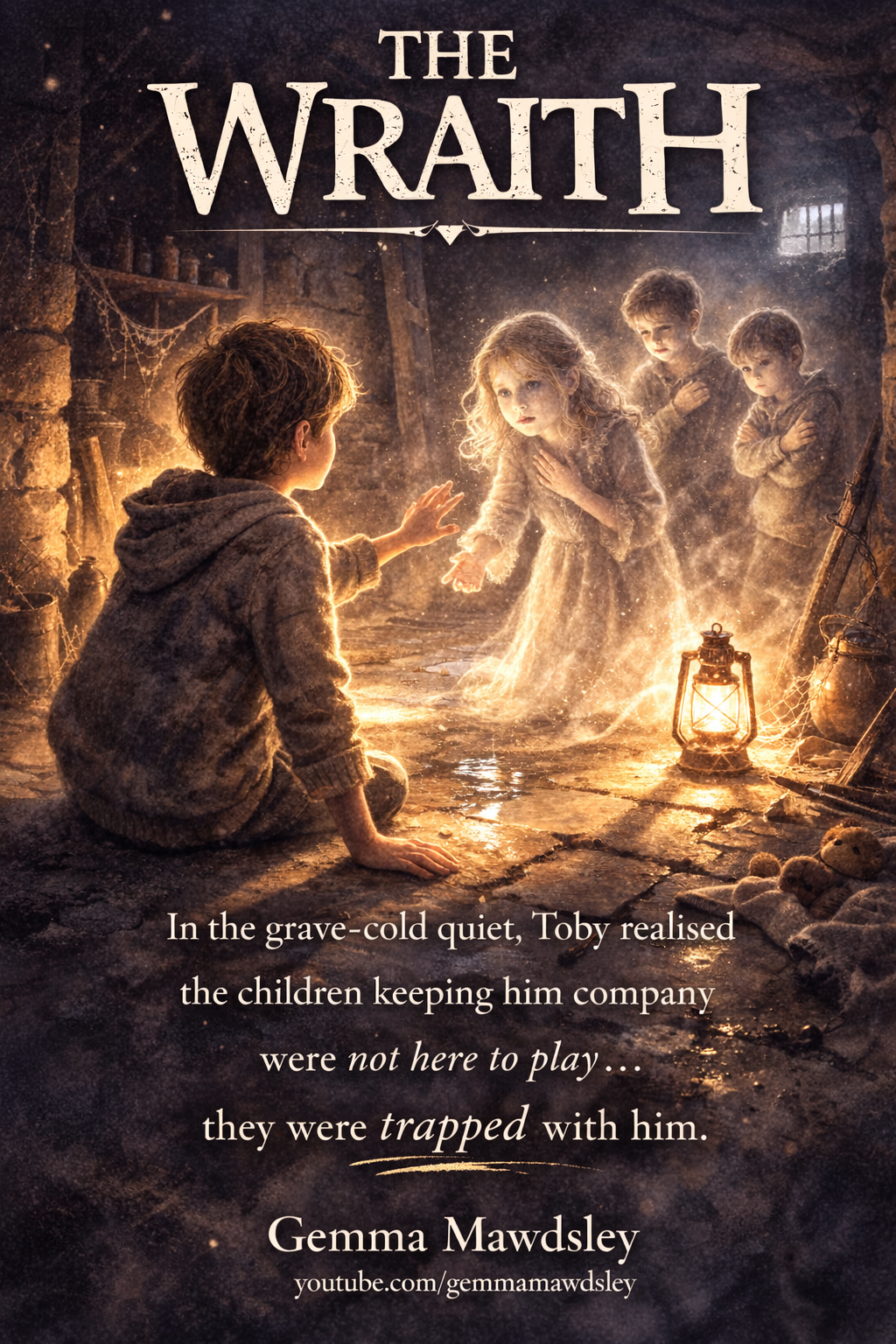
Though Toby still had the sniffles, the fever had passed, and he was able to sit up in the bed. His throat was sore, but the last of the drinking water ran out hours ago. The children sat on the bed beside him and tried to cheer him with stories and jokes.
“That was just stupid,” Toby laughed at Raymond’s last joke.
“Made you laugh, though,” he smiled.
“Yeah, but it was still stupid,” Rachael said, giggling.
They were all having a fun time, when footsteps sounded on the floor overhead. As men’s voices drifted down, Toby felt the others grow tense.
“The bad men,” Paul whispered.
Toby whimpered with terror and clutched his superman doll closer to his chest. When the door above his head opened, Rachael dragged him out of the bed. They ran into a corner of the room and crouched in the shadows.
“Christ, it stinks down there,” he heard one of the men say, as a ladder was lowered into the cellar.
“Leave the door open a while,” someone else replied.
Once the foul-smelling air escaped, the monsters would be ready to begin their work. None of them checked to see if he was still alive.
Toby’s stomach hurt and the pain got worse when he realised the children were no longer beside him. He felt along the wall, hoping to find a way out, but there was none.
“They left us,” he whispered to the superman doll. “They left us.”
He was too tired and too sick to cry, so he stayed huddled in the shadows.
Freddy was first to climb down the ladder. He carried an old-fashioned oil lamp as they never bothered to have electricity installed and didn’t want the trouble of housing a generator. He held up the lamp and his eyes searched the gloom until he found the crouched shape in the corner.
“Come out.” He lifted the boy up with one hand and carried him across the room, before dumping him onto the bed. “Bring some water down here,” he called up to those overhead. “We have to wash him.”
“My throat hurts,” Toby said, expecting that this man, this grownup would help him.
Instead the man ignored him and went to the big cupboard in the wall and opened it. Toby scooted down the bed to get a better look at what was inside. There were strange, shiny things. Someone else was coming down the ladder. This man carried a bucket and Toby heard the water sloshing about.
“Here,” Christy pushed a bottle of water into Toby’s hands, but the child was rigid with fear.
He never felt the bottle leave his hands and was only vaguely aware of the lip being held to his mouth. The pain in his throat eased a little.
“Up you get,” strong hands lifted him and made no attempt to stop the man who peeled the sodden clothes from his body.
The water was icy, and he shivered as the cloth rubbed over his fevered skin. If he closed his eyes, he could have been home, with his mother washing him, but the water would not have been so cold there and he would not have been so frightened. A big towel wrapped around his body and he automatically started to rub his skin dry.
“Can I have my clothes back?” He asked the man gathering them into a bundle.
“No, you won’t need them,” the man smiled, as Toby looked up at him for the first time.
In that instant, he understood what was happening.
The other man, the one who was busy sorting thing in the big cupboard, walked to the foot of the ladder.
“We’re ready when you are,” he called.
The sound of heavy footsteps on the bare boards pounded overhead and a shadow appeared at the mouth of the trap door. Toby watched the legs appeared and another man climbed the ladder backwards down to the cellar. Toby eased back down onto the bed and picked up his doll.
“Help me, Superman,” he whispered, as the latest arrival turned around to look at him.
With a cry of delight, he jumped up and ran to put his arms around the familiar figure.
“I knew Superman would save me,” he smiled up at the man. “Oh, Sir, I was so frightened before you came. Can we go home now?”
“No, Toby,” the man ruffled his hair. “I’m afraid we can’t.”
“But, Sir,” he looked up at his teacher. “Why not?”
It came again, that terrible understanding and Toby started to back away. He held the towel closer as he crawled up onto the bed and huddled down in the corner farthest from the men.
“You’re supposed to mind me, Mr Jackson,” his eyes were filled with accusation. “You’re not supposed to be a bad man.”
“But I am, Toby,” he took a proffered strap from Freddy’s outstretched hand. “I’m a very, very bad man.”
Toby lay on the bed, afraid to move. He had just woken and had was unsure of where he was. He knew he wasn’t at home, and if he called out, there would be no familiar voice to answer him. Kneading his fingers into the sour-smelling quilt beneath him, he tried not to cry. The darkness all around seemed absolute, and he was terrified at what he would find, if he sat up. His face was sticky and smelled bad, so he brought his hand up, and touched the wet spot on his chin. His stomach had rebelled against the fumes of the chloroform.
“Ouch,” he could not suppress his groan of pain.
The drug-soaked cloth was pressed against his skin with such ferocity it had burned his nose, cheeks and chin. Of course, he was unaware of the red marks that marred his face and knew only that he was hurt. His throat ached, adding to his discomfort and he bit down hard on his sore lip. The memory of his ordeal was returning, and he tried to hold back the tears. Squeezing his eyes shut, he prayed this was all a bad dream and he’d wake at any moment in his own bed.
“Mam?” his question echoed in the silence of the dark room.
There was, as he had expected, no answer, and he pulled his knees up and rolled into a ball in the centre of the bed. Despite the fact he was still wearing his anorak, he was shivering, and the air around him felt cold and damp. Something nudged against his side and hurt him. Allowing his hand to move down to the source of his discomfort, he felt in his pocket.
“Superman,” he held his favourite action figure against him, glad of the company in this strange place.
The softness of the doll’s cape felt good against his skin, and the familiar scent made Toby feel just that little bit braver. Sitting up, he wiped his face with the back of his hand.
“Yuck.” There was residue still in his mouth, so he spat and wiped his hand on the quilt.
With Superman in one hand, he edged his way back on the bed, to where he imagined the headboard would be. To his surprise, his back met the bare wall and damp, cold wood.
A small light glowed in one corner of the room, but it did little to dispel the gloom, and there were dark shapes everywhere.
“Hello,” he called, hoping someone would hear him.
He held his breath, as he waited, but there was no one. The only sound came from the slight throbbing of a motor somewhere far away. In the distance, he heard the gentle crying of the wind.
Moving to the edge of the bed, he felt the solidness of the earth beneath his feet and stood up.
“Don’t be afraid,” he whispered to the doll. “We’ve been in worse situations.”
Mimicking the words of his hero, he felt his way around the room. The first item throbbed beneath his fingers and buzzed like a swarm of bees. It was cold and shiny to the touch. Letting his hand move down to the front, he located a handle and pulled. Instantly the room glowed with light, as the fridge door opened. He studied the contents and was relieved to find it filled with all sorts of goodies. Mostly the kind of stuff his mother would not allow him to eat. There were lots of fizzy drinks, chocolate, biscuits, some cheese, ham, butter, bread and loads of other stuff. Four large cartons of milk lined the door, but what boy could resist cola, and he took a can off the shelf. The hiss of the carbonated drink filled the room, as the metal pull gave way and he gulped, aware once again of the pain in his throat. The sugar rush worked its magic, and he burped loudly, delighted by the sound.
Leaving the door open, he used the light to find his way around the rest of the room. Chomping on a biscuit, he searched his prison. There was a large cupboard set against one of the walls a stout lock guarding whatever was inside. He flinched and pulled his hand away, when he touched the heater. Although barely warm, it was a surprise to find heat of any kind, and he traced his fingers along the accordion shape and down the side. Locating the button that regulated the heat, he pressed it down another notch. By the time he was finished looking around, the room was already becoming much warmer and he took his anorak off.
Some things in the room puzzled him. Like the old-fashioned iron bath and he shivered, hoping he was not expected to wash in it. Beside it sat a weird thing, shaped kind of round, and he lifted the lid and peeped inside. It was a toilet, of sorts, more of a big potty really, and he knew he would never use such a thing. After all, he was seven years old.
The novelty of searching his new surroundings soon wore off, and even Superman was beginning to lose some of his initial bravery. Toby climbed back onto the bed and wondered what he should do next. The fridge buzzed loudly, protesting the intrusion of warm air into its icy innards. His mother often scolded him for leaving the door open, and he knew he should close it, but was afraid of the dark. Still, he thought, the food might go bad if he didn’t, and sliding off the bed, he walked over and pushed it shut. Instantly the room was bathed in shadows, and he hurried back to his place on the bed. Holding the doll against his face, he moved his lips over the ridges that served as curly waves on its head.
“What’ll we do, Superman?” He wondered out loud.
I won’t cry, he thought, I’ll think of a plan to get free. He felt tired, and since there was no clock in the room, and no window to show what time it was, he decided to sleep. Turning the quilt over so he didn’t have to lie on the vomit stains, he lay down and placed the doll on the pillow beside him. It was just possible to make out the red and blue of the costume in the dim light, and he was glad he always carried the figure with him. It would have been extra scary without Superman.
As his head filled with plans, each one more daring and dangerous than the last, he tried not to think of his mother and home, but it was no use. The tears that welled up in his eyes were so big they burned and refused to stay back.
“I’m not afraid,” he assured the doll. “I’m just worried about my Mam. She’ll be missing me by now.”
The doll’s expression never changed, and Toby took this as a sign it understood what he had said was true. Sniffing and wiping away the tears, he lay back down.
“Did you know he was a bad man?” he asked.
When Superman didn’t reply, Toby thought he probably had known. If he had tried to warn him, then Toby had not heard, but it was hard to be heard when you’re stuffed into someone’s pocket.
“Never mind,” he patted the cold plastic of the doll’s chest. “We’ll think of something.”
As he drifted off to sleep, Toby couldn’t help but remember the bad man.
It was cold that day, and he waited until after everyone had gone, to go looking for his mother. She was never late, and he knew he should do as she asked, and stay inside the school railings until she came, but he was freezing. He heard the bang as the huge door was closed, and he walked to the edge of the building and watched as Mr Jackson turned the big key. He was laughing with Mr Keane about something, and Toby wondered if he should go and tell them his mother was late but decided against it. The men didn’t see him, as the teachers’ car park was on the opposite side from the school gates, and it felt weird and kind of nice to be left alone in the empty playground. For a while he ran around in the side yard pretending, he could fly. With Superman in one hand, he jumped and swirled until he was tired and dizzy. Going back to the gates, he was surprised his mother still had not arrived, and walked outside to look down the road, in the direction in which she would drive.
Sighing, and not willing to wait any longer, he started off in what he believed to be the way home. Passing the shops and the police station, he waved now and then to the odd friend, who was still shopping with their mothers. Soon there was no pathway to walk on, and he had to skim along the verge of the road. There were hardly any cars, once he had left the village, so there was no need for him to hop up on to the grass. He stopped only when he heard a motor approach and jumped on the mound beside him. To his surprise, the car stopped, and the driver wound down the window.
“Hello, Toby,” the man smiled. “Your mother sent me to collect you. She’s had to take Bess to the vet. It seems that the dog got into an argument with a hedgehog and got herself spiked.”
“I don’t know,” Toby looked at the door that was pushed open from inside.
His mother had always warned him about getting into strange cars.
“Hurry up,” the man glanced in his rear-view mirror. “I haven’t got all day, I have cows to milk, and I’m doing this as a favour to your mother.”
Well, Toby decided, he did know about Bess, and his mother would be cross if he didn’t take the lift.
“Thank you,” he climbed in and was about to haul his satchel after him, when a movement in the corner of his eye stopped him.
His eyes opened wide with terror as the man grabbed him and held a cloth over his mouth. He struggled, unable to breathe, and tried to push the hands that held his head in a vice-like grip away, but it was useless. He felt the satchel slip from his fingers as the fumes overcame him, and he remembered nothing more until he had woken in the cold, dark room.
He cried out in his sleep as the memory of the suffocating cloth on his face returned.
“No,” he screamed, jumping up in the bed.
Sweat made his clothes cling to his body, and the heat intensified the stench of the room. The reek of mustiness and damp earth was choking, so he slipped from the bed and walked over to switch the heater off. He was panting and could feel his hair sticking to the back of his neck. Pulling off his school jumper, he used it as a towel to wipe his face. The draft from the open fridge cooled him as he searched inside for another cold drink. He held the can against his cheeks, until he got his breathing under control, and his heart stopped racing. He knew it had not been a bad dream, and what he recalled had really happened, but it was beyond him why the man should have taken him. He was too small to be a slave, he reasoned, maybe the man had no little boy of his own and wanted one. Either way, he had done a very bad thing in taking Toby, and the police would be very angry. His mother would have told them by now, and they would be looking for him.
There was a noise above him head. A scratching and digging that was, in fact, nothing more sinister that the nocturnal foraging of a fox, but to Toby’s terrified imagination; it became a monster trying to claw its way in. Leaving the fridge door open, no longer caring if the food went bad; he ran back to the bed and grabbed his Superman doll.
“Go away,” he screamed, braver now that his superhero was close. “Leave us alone.”
The fox picked up its ears at the sound and scampered away into the trees. Toby sat shivering and looking up to where the sound had come from. It was gone now, he decided, the monster must have realised he was not alone, that Superman was there too.
“I hope they come for us soon,” he told the doll, before curling up against the cold wood on the wall behind the bed.
In his mind, he pictured his mother rallying the police to action, and the millions of people who would be looking for him. He had seen on the news how helicopters were used in searching for missing people, and he wondered if he would get to ride in one of them. Anyway, he thought, pulling the foul-smelling quilt closer; if the police don’t find me, Bess will. She was a great tracker and could always sniff out the rabbits in the orchard, so she would probably guide them to him. They could always ask his mother. She knew everything, and she could even read his mind. He knew this, because she could always tell if he was lying. It was impossible to hide anything from her. She was aware of the most secret things like if he didn’t brush his teeth or finish his homework.
Despite the light from the open fridge door, there were parts of the room that were still hidden, and he tried to not to think of the things that might be lurking there. Reaching out with his mind, he called to his mother. Mam, help me, I’m locked up in a big, scary, dark room and I want to come home.
Covering his face with his hands, he screamed, as the shadows that had lain in wait swooped from the corners of the room.
CHAPTER FOUR
It was the smell that woke Sarah. Its scent wafted through the cracks in the wall, as her mother lit her first cigarette of the day. There wasn’t any need for an alarm clock, as this event was her signal to rise. The stench of the tobacco was everywhere. Its willowy trails permeated her clothes, her books, even her skin and hair. Despite keeping the bedroom door shut, it managed to sneak its way in, but its odour was nothing compared to that of cats.
The pounding of her mother’s fist on the wall roused her, and she slipped from beneath the bedclothes. The room was freezing, and when she pulled back the thin curtains, the glass inside the window was transformed into a crystal spider’s web. Shivering, she touched the pattern and watched as the ice melted beneath her fingers.
“What is it, Sarah?”
The whisper from the bed made her draw back her hand.
“It’s ice, Brian,” she smiled at her little brother. “It’s going to be a chilly winter this year.”
“Oh, no,” he groaned, and pulled the covers back over his head.
Though ten-years-old, the memories of past winters were fresh in his mind, and the nights of bone-numbing cold couldn’t be erased. The cottage was a tumbledown affair, built in a time before insulation or central heating. It was tiny in comparison with modern standards. On one side of the building there was a kitchen, which also served as sitting room. A small hallway led to the two bedrooms and an ancient bathroom, where the plumbing was salvaged from another age. There was no boiler and consequently no hot water, other than to boil a kettle on the old stove in the kitchen. This was Sarah’s first task of the day, once she’d brought breakfast to her mother, to boil enough water to wash them both.
“Stay there,” she patted the humped shape under the covers. “I think there’s some eggs in the larder, I’ll call you when they’re ready.”
“Thanks, Sarah,” came the muffled reply.
Since the cottage was small, she had to share a room with her brother. Although he could be a bit of a pain at times, she didn’t mind. They were used to respecting one another’s privacy, when it came to dressing or undressing. With two small single beds, there wasn’t much room to move. An old tea chest, her mother found, served as their wardrobe. What little clothes they had were folded inside, and despite Sarah’s attempts to clean away any evidence of its cargo, the black grains of tea managed to get in their clothes and had to be shaken away like the husks of dead fleas.
Slipping her school jumper over her nightdress, she walked into the hallway. It seemed colder here, and she hurried towards the kitchen, hoping to find warmth in the fire’s dying embers. The smell felt like a smack in the face, when she opened the door, and she drew back in disgust. She waited for the shock from the acidic fumes to pass, before attempting to go in. Her mother, aware the night would be a cold one, allowed her menagerie of cats to sleep indoors. Most were feral strays, which the confines of the room terrified, and they’d shown their displeasure by the amount of faeces and pools of urine lining the stone floor. Tired from numerous attempts to escape, they’d settled down in front of the fire or on top of the table. Once Sarah appeared they arose en-mass, arching their backs and yawning. Some mewed piteously; others narrowed their eyes and hissed.
Holding her hand over her nose, Sarah tiptoed across the room, trying to avoid the puddles on the stones, but it was difficult in the half light. She felt the wetness on the toes of her worn slippers. Flinging back the curtains, she threw open the window and picked up a broom.
“Out,” she ordered the last of the stragglers, who unlike their comrades refused to make a bolt for freedom. “Out, I said,” she swung the broom at the nearest group hitting a ginger tabby, who snarled at her before heading for the window.
Once they’d disappeared into the bone-chilling mist outside, she’d no choice, but to let the window to stay open. The fumes burned the lining in her nose, as she placed the kettle on the stove. As she waited for the water to boil, she started cleaning up the floor. Using an old newspaper, she managed to pick up most of the faeces, but the smell was too much on her delicate stomach, and she decided to leave the rest for her mother to deal with. The water from the lone tap in the sink stung her hands like needles of ice, as she washed away the dirt of the cats’ droppings.
Taking two eggs from the larder, she placed them in pot of water to boil. Brian would have to eat his breakfast in the bedroom, as there was no telling what germs were floating about in the kitchen. The kettle bubbled, so she placed some teabags in a pot and filled it. While she waited for it to brew, she took the loaf of bread out of the larder and tried to cut it on a small board on her lap. There was no way she’d use the kitchen table, not until it was scrubbed clean, and this would have to wait until after school. It was difficult to cut the loaf, and she wondered for the millionth time, why her mother insisted on buying the uncut bread. Sarah’s life would be so much easier if she’d buy sliced bread. The old rusty fridge yielded nothing more than some sliced ham, and this was curled and dry around the edges. The packet said it was still in date, and it she used to make sandwiches for her brother’s lunch. Sarah never took anything other than a slice of bread and butter. She rarely felt hungry, and if she did, she could eat it quickly before anyone saw the huge chunk. An assortment of paper bags was crushed into a dresser drawer, and she chose the cleanest two to wrap their lunches. God forbid, they should have cling wrap like civilised people.
The eggs were bubbling when she finished, and she’d forgotten the cold streaming through the open window, as she scooped them out of the pot. Making two small cone shapes from old newspaper, she placed an egg in each. Picking up a spoon and a slice of bread, she carried them back into her bedroom.
“Here you go, lazy bones,” she tapped her foot on the side of the bed.
Her brother emerged from beneath the covers.
“Don’t think I’ll be doing this every day,” she warned. “The bloody cats were in all night and the kitchen stinks to high heaven. Can you manage?” She asked, as he tried to balance to eggs.
“Yeah, no problem,” he tapped on the top of the egg.
“O.K., don’t get shell everywhere, or you won’t be able to sleep tonight if it gets into the sheets.”
“Hey, Sarah,” he called, and she turned back. Waving the egg-filled spoon at her, he smiled. “Look at me, I’m like a King.”
“Well, hurry up, King Brian,” she laughed, “You’ll need to have a wash before school.”
A harsh, racking cough from the room next door signaled her mother’s discontent at being kept waiting for her breakfast.
“Excuse me, my lord,” Sarah whispered, bowing to her brother, before hurrying away.
Chapter Three
“I swear before God,” her hand closed on the crucifix hanging around her neck. “Nothing you say to me will leave this room, and I do want to help, in any way I can.”
He knew she was sincere in her offer, and not one to go about spreading idle gossip. Like him, she was lonely, and the lines on her face told their own story. Life wasn’t easy for her.
“It’s nothing concrete, you understand,” he decided to trust her. “And I can’t betray what I heard in the confessional.”
“I understand that, Father,” she nodded. “I wouldn’t dream of asking you, but if telling me a little of what bothers you eases the burden, I’d like to help.”
“You know about the two sudden deaths last October?” He asked.
“Yes, the suicide and the murder.”
“You think one of the deaths was murder?” Her answer amazed him, and gave him comfort he wasn’t alone in his suspicions.
“The whole place knows it was, but as the coroner said, there was no proof, and the murderer got away with it.”
He sat back in his chair and closed his eyes for a moment, relieved the wickedness in his own thoughts was echoed by others.
“I heard their last confessions,” he roused himself and went back to his tale. “Only hours before they died, and I did nothing to help.”
“How could you, Father?” Norah asked. “As you said the confessional is sacrosanct.”
“The knowledge gives me little comfort, I’m afraid, but you’re right. I couldn’t break the seal of confession, and it haunts me. That, and the promised each of them made to me,” his eyes grew troubled. “It’s exactly a year ago tonight, you know?”
“No, I didn’t know,” Norah pulled her coat around her shoulders. “I knew it happened around this time, but not the exact date.”
“I knew each of them well,” he said. “I christened little Sarah Jacobs. She was fifteen when she died, and I met Lorraine Ryan on the day she moved here,” he looked around the room. “I called offering to help with the move, but she’d little material possessions, and most of the furnisher was falling to pieces, but she was glad of the offer, and we became friends. You know in the old days,” he said. “I’m not talking about the last century or the one before, but going back maybe forty years ago, they buried suicides outside the walls of the graveyard, and not only suicides, but babies who were not baptised and unmarried mothers. They thought them unfit to lie in consecrated ground, God help us,” he put his head in his hands and his voice was muffled. “So much harm was done in the name of God.”
“They were superstitious times,” Norah said. “I remember reading how they buried suicides at crossroads with a stake through their hearts.”
He looked up at her.
“Well, we haven’t come far since then.”
“It’s this place, Father,” she said. “Folk have little to occupy their time, and the old superstitions die hard. It’s different in the cities with the drugs and people overdosing right, left and centre.”
“Ah, now, Norah,” he laughed, at the casualness of her words. “I don’t think they’re dying that fast.”
“Well, you know what I mean,” she sniffed and straightened her shoulders.
“I know,” he didn’t want to offend her. “It seems like it, if the news reports are to be believed.”
“The young one,” Norah asked. “Did you know her?”
“Sarah, yes,” he paused. “Better than I know most of the young ones. I’ve met them at communion and confession, but many have moved away from the church. Sarah sought me out during the last few weeks of her life, both did. That’s why I know so much about them, and there’s no harm in telling you what I know. What I do know of Sarah is her life wasn’t an easy one. Have you met her mother, she’s the one with all the cats?”
“I know who you’re talking about. You can smell the cottage before you see it. She strikes me as a bit odd in the head.”
“That’s her; the poor woman should’ve been hospitalized years ago, but her husband wouldn’t hear of it. You haven’t been here long enough to know any of their stories, have you?” He asked.
“No, I’ve just picked up bits and pieces of gossip from the locals,” she said.
“Would you like to hear the truth?”
“Yes, Father, indeed I would.”
He consulted the clock on the mantelpiece.
“We’ve a few hours before mass and their stories will take some time in telling, but if you’re willing I’ll tell you how each of them came to be lying prematurely in the grave. Then you can judge if they’re at rest; or if as I suspect, tonight will see the beginning of a nightmare.”
“I’d be glad to listen,” Norah croaked, her mouth was dry from the tension.
“It’s hard to believe I used to enjoy the solitude of my calling. My sleep was free of terrors and my days spent in restful study of my books. It seems so long ago now, and it was brought to an end by what I’m about to tell you.”
His voice, once he began was unstoppable. There was a gluttonous intent in his outpourings. Norah settled back in her chair and nestled deeper into the warmth of her coat. She tried to make her face remain impassive, and did nothing to interrupted as the sad panorama of the two lives unfolded.
Father Brown watched her, looking for signs of disbelief. He knew as he spoke, she thought he was exaggerating, or the events were clouded, as his mind grew feeble with age. Still, he couldn’t miss this opportunity to unburden himself, and if as he suspected, the night ahead was filled with horror, there’d be someone who knew the truth.
Tonight, he’d face his demons. Though this word was not one he’d use to describe the poor, restless souls in the churchyard. The trauma and turmoil each felt at the last moment wouldn’t have left them unaffected and this was what he dreaded most. It was the one thing he couldn’t divulge to Norah, the urgent, angry whispers he’d heard in the confessional, as each one vowed revenge on those who’d hurt them.
CHAPTER TWO
The air was colder than when she entered the church. Though it was still early in the afternoon, Norah saw the glitter of frost on the grass. Tying her headscarf under her chin, she hoisted the heavy shopping bag she carried into the crook of her arm, and set off the short distance to the priest’s house. Weaving her way along the path leading to the side gate, she couldn’t help, but notice how the style and size of the headstones changed over the years. The grander ones, carved into the form of angels in white granite from the local quarry, were outnumbered by the smaller, marble markers. Muttering a prayer for those lying beneath the earth in restless sleep, she crossed herself and tried to banish such thoughts. It’s the time of year, she decided, it sends the imagination wild, and it was any wonder. Everywhere you looked there were effigies of monsters or skeletons. It was enough to give somebody nightmares.
Flecks of old paint came away on her hands, as she pushed against the latch on the small gate. The hinges were rusted with age, and groaned protesting the intrusion, as she pushed it open. Tutting, she surveyed the grey flecks on her fingers, before running her hands down the front of her coat. It wouldn’t do to turn up for tea with dirty hands, and she was fussy about cleanliness. Like the gate, the front door was showing signs of wear, as she lifted the old-fashioned knocker and tapped twice.
“Come in, Norah, come in,” Father Brown opened the door and stood aside to let her pass.
Though stooped with age, he was much taller than her, and she felt dwarfed in his presence. The hallway was dark after the glare of the sun, so she stood for a moment to let her eyes adjust.
“This way,” he motioned, and she followed his dark silhouette. “I have the fire lighting in here,” he opened a door and led her into the sitting room. “I’ll be back in a moment,” he gestured to a chair. “You make yourself comfortable.”
“Thank you, Father,” Norah allowed the shopping bag to slip from her arm and took off her coat and scarf.
She heard him rattling about in the kitchen preparing the tea, and this gave her time to look around. Despite the blazing fire the room was chilly, and she rubbed her hands down her arms, trying to bring life back to her cold skin. Like the hallway, this room was shrouded in shadow, and seemed to come from another time. She knew it wasn’t a phoney attempt by some designer trying to replicate the Victorian era, but the way the furnishings had been for over a hundred years. The stuffed armchairs were comfortable, though faded with time. The arms showed the most sign of wear, as the brocade was worn and stuffing protruded through the fabric. Yellowing antimacassars draped over the back of each chair. On the mantelpiece above the fire, a black, ornate carriage clock ticked loud enough to make its presence felt. An old china cabinet held an assortment of cups and plates, and on top sat a stuffed owl in a glass dome.
“Here we are,” Father Brown shuffled in and put a stop to any further probing. “It’s going to be a bitter night,” he placed a tray on the coffee table.
She saw how his hands shook, as he reached for the teapot.
“Here, Father,” she stood. “Let me do it.”
He relinquished this task, and moved away to sit in the chair opposite.
“There you go,” she placed a cup and saucer on an occasional table beside him and offered the sugar bowl. For a while neither of them spoke, and she watched, as he stared into the flames. His face showed signs of strain and his brow furrowed, as though he was trying to remember something. His eyes had the haunted look she’d noticed developing over the past weeks.
“Are you all right, Father?” She asked.
“I’m fine, Norah,” he turned and looked at her. “Feeling my age, that’s all.”
She concentrated on stirring her tea. The only sound came from the clanking of the spoon against the sides of the cup.
“Are the graves troubling you, Father,” she asked. “The ones that won’t settle?”
He nodded, and fumbled in the pocket of his threadbare cardigan for a handkerchief. She noticed, as he wiped his eyes, how the veins showed on hands shrunken with age. Despite his years, his dark hair lost none of its colour with just a scattering of grey at the temples. Rather than giving him a more youthful look, it served to emphasise the pallor of his skin.
“I’m sorry if I’ve upset you, Father,” Norah didn’t know what to do. Should she stay sitting or make her excuses and leave?
“No, no,” he brushed aside her apology. “It’s nothing you said. I’m feeling a bit run down, and now with the worry…” he stopped and looked towards the window.
She knew he was picturing the graveyard.
“I heard some foolish talk,” Norah tried to brighten the mood. “You know how it is here, Father, with everyone caught up in everyone else’s business.”
“I’ve heard it too,” he turned back to her. “But what troubles me the most is how foolish is it?”
“Come now, Father,” she laughed. “Surely you don’t believe in those old wives’ tales?”
“I don’t” he paused. “At least I didn’t, until now.”
Norah shivered. Sensing her distress, he smiled.
“I’m not going to bother you with my nonsense,” he emptied his cup and held it out for a refill.
“I know it’s not nonsense, Father,” Norah picked up the teapot, glad of its warmth. “I’ve noticed how you’ve changed over the past few months. Perhaps, if you talked about it?”
“Perhaps, perhaps,” he sighed, and sipped at his tea.
The shops are filled with garish costumes and the faces of ghouls, ghosts and witches line the aisles of most supermarkets as the children prepare the celebrate the season. It is a time for fire crackers, toffee apples and the breathless excitement that is Halloween. But there is another side, and one that will never change, and that is the sight of the candle in the window of most homes, as they light the way for their lost loved ones. As the flame cuts through the darkness, we want them to know that there is light even in the darkest place, and they are not forgotten. Names will be whispered about around roaring fires as we remember better times and better people. Many a tear will be shed, as on this night, when the veil between the worlds is at its thinnest, our loss is somehow more profound. There is nothing strange or sinister in these beliefs, as here in Ireland, we live happily side by side with all manner of creatures be they ghost, wraith or banshee. So, we wait, as the dark nights come creeping in to honor our dead and leave an extra log on the fire before going to bed—just in case.
CHAPTER ONE
Tonight, belongs to the dead and the living would do well to remember it. Father Brown tried to brush aside such morbid thoughts and smiled as another small group, comprised of witches, ghouls and a lone grim reaper swept by. He shivered and drew his coat collar around his throat. The wind carried with it a penetrating chill, and the last of the autumn leaves swirled around his feet, as he walked up the path to the church door. He looked neither left nor right, not wanting in his gloomy mood to acknowledge those of his parishioners lying beneath the earth. There was no mistaking the tremor in his hand as he tried to place the key in the lock, and it scraped against the brass surround leaving a deep scratch.
“Christ,” he licked his thumb and rubbed at the offending mark, but the metal from the key cut deep, and it would take more than a gentle rub to remove it.
He stopped to allow the trembling in his hands subside, and his eyes travelled up to the porch above his head. The doorway was unremarkable by some standards, though the archway was cut from a single stone. It was devoid of the finer carvings of scrolls or angels, but this wasn’t uncommon for a church in a rural community. Its congregation were unused to frills and flounces, the bishop informed him, as he handed over the keys to Father Joe’s first and only parish. He waited over forty years for this honour, and served his time as curate and underling to a host of priests, without a murmur of discontent as the younger and less experienced were promoted before him. He bided his time, and patience paid off. He’d been serving in this parish for over twenty-four years, and never once had he cause to regret it, until now.
Wanting to be free of these thoughts, he turned back to the door and this time managed to turn the key in the lock. The interior of the church was icy, and he cursed the ancient, unreliable heating system as he walked down the shadowy aisles. The evening mass wasn’t due to start until seven, so there were hours yet before his services were needed. Until then he’d be left alone with the horrible grey mood that descended. Edging his way into a pew at the centre of the church, he knelt in silent prayer until the ache in his knees urged him to sit. His tired eyes roamed around the familiar interior. It was an ordinary building, with no cellar beneath it to hide the tombs of past gentry, and no stone effigies of fallen knights to mar the aisles. The windows the usual semi-circular arch, and the stained glass showed a parade of saints and sinners. At the side of the altar sat the baptismal font. Carved from a huge stone hollowed to house the holy water, it sat unused and forlorn. It was years since the last christening, and it lay empty with just a small, green lime stain coating the bottom. The younger members of his congregation moved away to the city as soon as they were old enough. Only those tied to the place by farms or family businesses remained, and it was to this dwindling number he preached each Sunday.
Behind him, rising to a point above the porch, sat the bell turret. To have called it a tower would be boasting. To his right sat the confessional. Double sided with a half door in the centre, and a heavy, green, velvet curtain to hide his face once seated. It’s here he’s listened over the years to sins, some real, some imagined, of those desperate for absolution. It is the place he heard the last words of those who haunted his sleep, and who now, as the night of All Hallows drew nearer, made his heart race with the certain knowledge of an approaching terror.
A sudden blast of wind carried with it the smell of altar flowers that outlived their life span. The thud of the church door explained the cause of the draught, and he didn’t bother to turn around to see who it was. The footsteps drew nearer, their sound echoing in the silence and amplified by the high-vaulted ceiling.
“Ah, Father, I thought it was you,” the old woman stopped beside the pew. “I’m here to change the flowers,” she held out a bunch of yellow chrysanthemums.
The autumn wind picked the gardens bare of blooms, so she had to buy the flowers, and she wanted to make sure everyone knew of her sacrifice.
“That’s good of you, Norah,” he looked at the offering. “You must let me reimburse you.”
“Not at all, Father,” she puffed out her chest. “I’m delighted to do it. It gives me something to do.”
He watched, as she took the small vases off the altar and into the sacristy. There came the sound of running water, as she emptied and refilled them.
“There, now,” she came back and replaced the vases, fussing over the way the stems sat.
He saw there were red carnations scattered among the flowers, though overshadowed by the larger blooms and ferns, they seemed to his tortured mind like blazing, crimson orbs.
“Are you all right, Father?” Norah came down from the altar and was watching him with a worried look.
“I’m fine, Norah,” he rubbed at his eyes. “A bit tired, that’s all.”
“You should be taking it easier at your age,” she said. “You’re not getting any younger. Then neither am I.”
“You’re right,” he smiled and eased his way up out of the hard-wooden seat. “I’ll go back to the house. It’s warmer there. Maybe, you’ll come over when you’re finished, and I’ll make us some tea?”
“I’d be delighted,” she flushed at the honour of being asked to take tea with the priest. “I’ll come over as soon as I’m done here.”
She watched his retreating figure with a growing sense of worry. Father Brown was not a robust man, but of late he seemed thin almost to the point of emaciation. Something was disturbing him, she was sure of it and maybe with a bit of coaxing he’d tell her over tea. Running a dust cloth across the top of the altar, she wondered about the stories circulating. In a rural area, where everyone knew everyone else’s business, it was impossible not to hear what was whispered about. Being a relative newcomer; she paid little attention to the superstitions and old wives tales, but still. She shivered, as her mind strayed to the two, bare mounds in the graveyard and the cause of the talk.
She’s not a bad sort, Father Brown thought, as he made his way home. Norah Byrne came to live with her daughter a few months before. Escaping the hustle of city life for the relative quiet of the country, was how she explained her decision. It couldn’t have been an easy choice, as her son-in-law was a huge, gruff man and not one given to kindness. There was no peace under his roof, and this drove Norah to take the unpaid job of church warden. Though the job itself didn’t entail much work, it gave her an excuse to leave the house, and she found, as Father Brown had, a sanctuary there.
His house sat a few yards from the church gates. Within a stone’s throw of the graveyard, he always joked “They won’t have far to carry me far, when my time comes.”
The path through the graveyard was coated with the last of the autumn leaves and they crunched beneath his feet. From deep within their withered dryness rose a heady, decaying scent of mould and damp earth. He stopped and listened for a moment. The only sound came from the sighing of the breeze and somewhere in the distance the screams of the children, as they went about their tricks. Halloween started early in the day. There was too much distance between the houses to make it safe to do so by night, especially for the little ones. The teenagers were a handful, but they kept their pranks away from the church, and for this he was grateful.
Leaning on the gate, he looked across the fields, splendid in their quilt of autumns, brown, green and gold. To the city dweller, a place such as this would seem out of time. Used to a life surrounded by noise and confusion, they couldn’t imagine one could walk down a country lane so overgrown with bush and bramble the branches met overhead, only to come across an old farmhouse nestled among this chaos. Or a place where everyone knew who you were, and could recount tales of your grandparents and great-grandparents. There was a lot of good in living in the country, he sighed, but it was only in the last year he’d come across its dark side.
The serenity he’d known was stripped away in one night, and the calmness of the graveyard lost to him forever. There was no way out for him, other than stagnate in one of those god-forsaken homes for retired priests. He refused to end his days listening to their endless reminiscences of what they believed to be better days. He’d rather die in the service of his congregation, than rot away in some elephant’s graveyard. He knew once he’d gone the church would be closed. It was no longer financially viable to keep it open, not with the ever-decreasing numbers coming to his services. His superiors allowed him to continue there because he made no demands on their coffers, preferring to bear the burden of the running costs from the meager amount collected every Sunday on the offering plate.
Turning around, he looked back across the graveyard. To anyone unaware of its terrible secret, it seemed peaceful, with its large elm and oak trees, stripped bare now, but nevertheless solid and strong. To his frayed nerves, it was dark and forbidding, the only colour came from the berries on the holly bush. Moving back along the path, he saw the first of the two graves. He knew there was talk about them, and though his religion forbade belief in such things, he felt it was true. He was weary and feeling every one of his eighty-two years. Leaning one hand on the nearest headstone for support, he made the sign of the cross over the mound. This exercise was repeated once more before he was ready to go home. The last year was a horror, for beside the usual, sad deaths either from old age or sickness; there were two more which filled him with sorrow and dread. Sorrow, because of the needless loss of life, and dread because of the way one of the departed sought out death. Suicide, the word made him shiver, and he tried to huddle deeper into the neck of his coat. The second grave belonged to a young woman whose murderer was unpunished, but what haunted him most, was the fact he knew, suspected would be a kinder word, something dreadful was about to happen that day.
It began as it always did at that time of year with confessions. Halloween was the day of souls, and this was obvious by the fresh bouquets of flowers adorning the graves. Those who came to pay their respects to departed loved ones, also came to confession for the first time in a year. It became a cleansing of sorts for those who were not inclined to frequent the church, and they went away with a sense of well-being, knowing their souls and conscience were wiped clean Whatever happened over the next twelve months would be dealt with in the same way. He remembered listening to the whispers from beyond the grill, and giving absolution to those seeking forgiveness. It was his policy to neither judge nor reprimand, as people were who they were, and nothing he could say would change that. Once the first small wave passed, he’d stayed there hidden by the curtain and in silent prayer, when the groan of the confessional door roused him. Sliding back the latch, he closed his eyes and waited. Even now he heard her voice in his head. Hoarse from unshed tears, she stumbled through her confession, desperate to be done. Despite the darkness of the box, he knew her. She was very young. Her sadness touched him and he remembered whispering.
“Let me help you, child.”
“Please, father,” she sobbed. “Give me absolution.”
He knew by her urgent plea any further attempt would send her running from the box, so he did as she asked. Shaken and unnerved by this encounter, he sat back and prayed. The door of the confessional opened for the second time, and he waited with bated breath, hoping the sinner’s tale would be nothing to disturb his sleep, but fate was against him. What he heard made him put his head in his hands in horror. By the time he was finished for the night, his nerves were tingling and icy fingers of fear crept up his spine.
By nightfall both were dead; one by their own hand, and his life was changed forever. What he heard in the confessional was sacrosanct, but this knowledge did little to sustain him, as he presided over the funerals, or tried to comfort the bereaved. Neither did it comfort him during the long nights, when plagued with self-doubt; he walked the floor praying for sleep to come. It was now one year to the day, and the memory of their last words echoed in his head. If they, who lay under the mounds, which refused to settle, and on which no grass would grow, could keep their word, this would be a night of terror for those they came searching for. Though the voice of reason told him this couldn’t happen, Father Brown couldn’t help, but wonder, if the need for revenge was strong enough to resurrect the dead.

 gemmamawdsley